


Hi all,
I’m very excited to announce that pitches for the sixth issue of Kernel Magazine are now open!
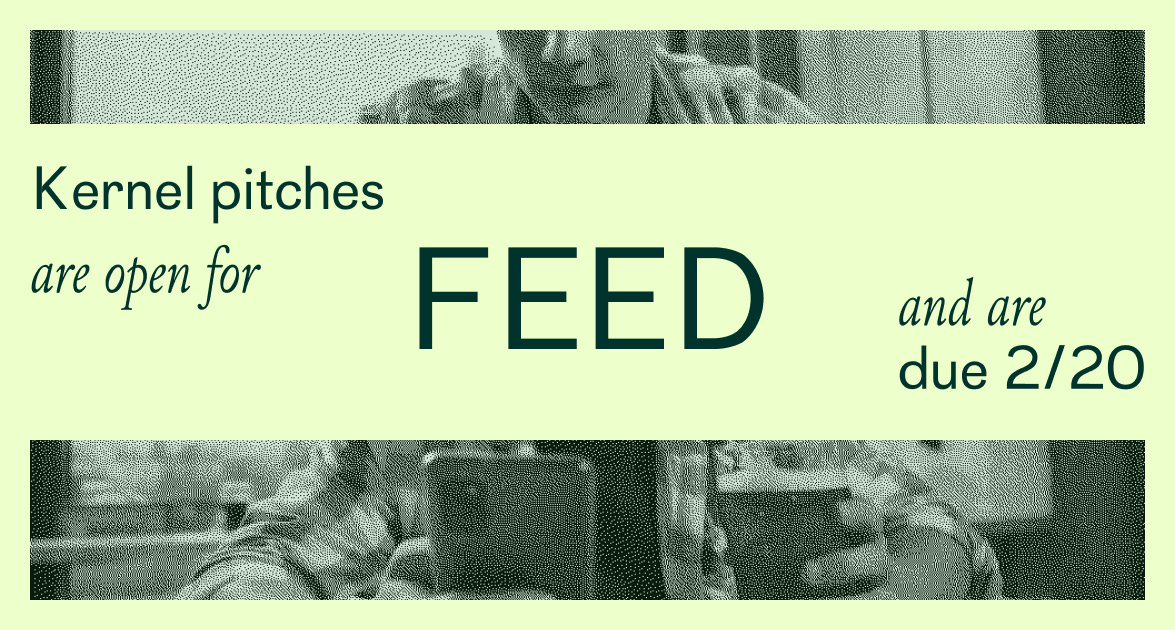
TL;DR: submit your pitches here (nonfiction) or here (creative) by February 20.
KERNEL 6: FEED
Kernel 6’s theme is FEED. In this issue, we’re exploring all the ways that consumption shapes our relationship to technology; what we feed upon, how it feeds upon us, and all the strange metabolic interactions in between. The feed has served as a load-bearing metaphor within our discourses of technology long before the development of the RSS feed in the late 90s, let alone Facebook’s introduction of the News Feed twenty years ago: consider the development of feeds in manufacturing processes in the 1890s, or the prominence of feedback loops in cybernetics a half century later. We are, of course, also interested in non-metaphorical feeding: what technologists eat, or drink, or inject; how technology has changed the ways we feed writ large. There is, I’m afraid, a lot to chew on.
What do we want to feed on?
As always, we’re looking for sharp, specific writing about technology by and for technologists — that is, “anyone who exercises agency to shape technologies toward their goals,” whether you “work in tech” or not. A technologist does not take the shape of technology today as a given or fixed point; this world is ours to shape (though we may not shape it alone, or purely through our own dreams and will.) If you’re reading this, you probably are already thinking, in some way, like a technologist!
We accept pitches for non-fiction essays and interviews (due February 20), and submissions for poems, short stories, and other forms of creative writing (due February 28). If you want to get involved as an illustrator, designer, or editor, let us know here!
Examples of things we’re interested in: An anthropology of the Venmo feed. Going to China to investigate the peptide supply chain. A critical reexamination of whether “software is eating the world”. Pizza arbitrage. Slop-bowl revivalism. What we’re feeding the machines, and how we source that feed. How technological regimes inform haute (and low) cuisine. Slurping through the rise and fall of Soylent. Finally answering why everything has a news feed now, even things that shouldn’t. Tell us what technologists eat in your part of the world and why it matters.
Some styles of inquiry we like: How do interpersonal relations (who’s friends? who’s enemies? who’s a “weirdo” and who’s “cool”?) shape macro-level politics, and what ultimately happens in the world materially? Where do values as stated conflict with values as practiced? Can theory be not just descriptive, but prescriptive in the real world? What concrete object or community can serve as a gateway to a larger point? How many things had to happen for this to exist? Give us your hottest takes and your most ambitious manifestos — just do the work to back it up.
Some modes of creative expression that intrigue us: Experiments in form; works that traverse both the printed page and digital media; speculative stories that follow a contemporary phenomenon to its logical (or illogical) end; text-based games; source code; lists; satire. What about the microscopic evinces something of the macroscopic? How can fiction, poetry, or visual art get at a contemporary circumstance, historical condition, or possible future from an alternative vantage point?
We won’t be excited by: “X won’t save us” or “capitalism is the root cause” or “techno-solutionism is doomed to fail” style arguments. “This thing sucks, actually,” sucks, actually. When thinking about what to write, we would rather plant a tree than visit a landfill — though, of course, soil can be fertilized by manure. Also, we’re not against writing about AI (and especially writing about what is consumed, materially and otherwise, in the process of its development), but just know that we’ll have a pretty high bar for quality and insight (unfortunately, when AI content is not good, it can be really not good).
What formats are we looking for?
As in previous issues, we have a few separate content tracks with separate submission forms. All contributions will be compensated; also, we increased our rates since last issue!
Nonfiction: essay, interview, or software criticism. Pitch here!
Essays and software criticism: short (1000-2000 words, $600) or long (3000+ words, $750)
Interview: $500
Creative: visual art, poetry, or fiction. Submit here!
For fiction and poetry, please specify if you are interested in your piece being workshopped/edited or if it is a final/completed piece.
Compensation will be $150-500 depending on the scale of the piece.
If you’re interested in contributing to Kernel as an editor, illustrator, or in any other role, let us know by filling out this form emailing jacob@joinreboot.org with your interests and relevant experience by 2/20. All roles will be stipended.
💝 closing note
Every time we put out a call for contributions for a new issue of Kernel, we are awed by the sheer range of pitches we receive — non-fiction, fiction, and those strange things between. We get pitches from every conceivable level of experience and perspective on technology, and feel genuinely grateful to read them all. If you have questions about contributing to Kernel or suggestions for future directions, we welcome your insight.
The Lead Editors of Issue 6 are Jacob Kuppermann (jacob@joinreboot.org), Shira Abramovich (shira@joinreboot.org) and Hannah Scott (hannah@joinreboot.org).
The Managing Editor of Issue 6 is Jacob Kuppermann; reach them at jacob@joinreboot.org.
The director of Reboot is Jasmine Sun; reach her at jasmine@joinreboot.org.
Have any questions? Read our guide on How to Pitch us, or send any of us an email. We eagerly await your pitches.
Reboot publishes free essays on tech, humanity, and power every week. If you want to keep up with the community, subscribe below ⚡️