


Over the course of the last century, one particular, calculating form of rationality has gone from a narrow mathematical framework to an organizing logic for much of society. Mathematical rationality has become part of how we understand everything from pharmaceutical trials and machine learning models to sports strategy and, for some, the decision-making of everyday life.
But is the adoption of mathematical rationality in itself irrational? Berkeley EECS professor Ben Recht’s new book seeks to answer that question, tracing the historical development of the concept across disciplines and technological moments to the present day.
Next Tuesday (3/17) at 5:30 PM: join us in San Francisco for an in person book launch party with Benjamin Recht, cohosted by Bloomberg Beta.
We’ll be discussing Ben’s new book, The Irrational Decision: How We Gave Computers the Power to Choose for Us.
Register for the event here, or read on for my review of The Irrational Decision:
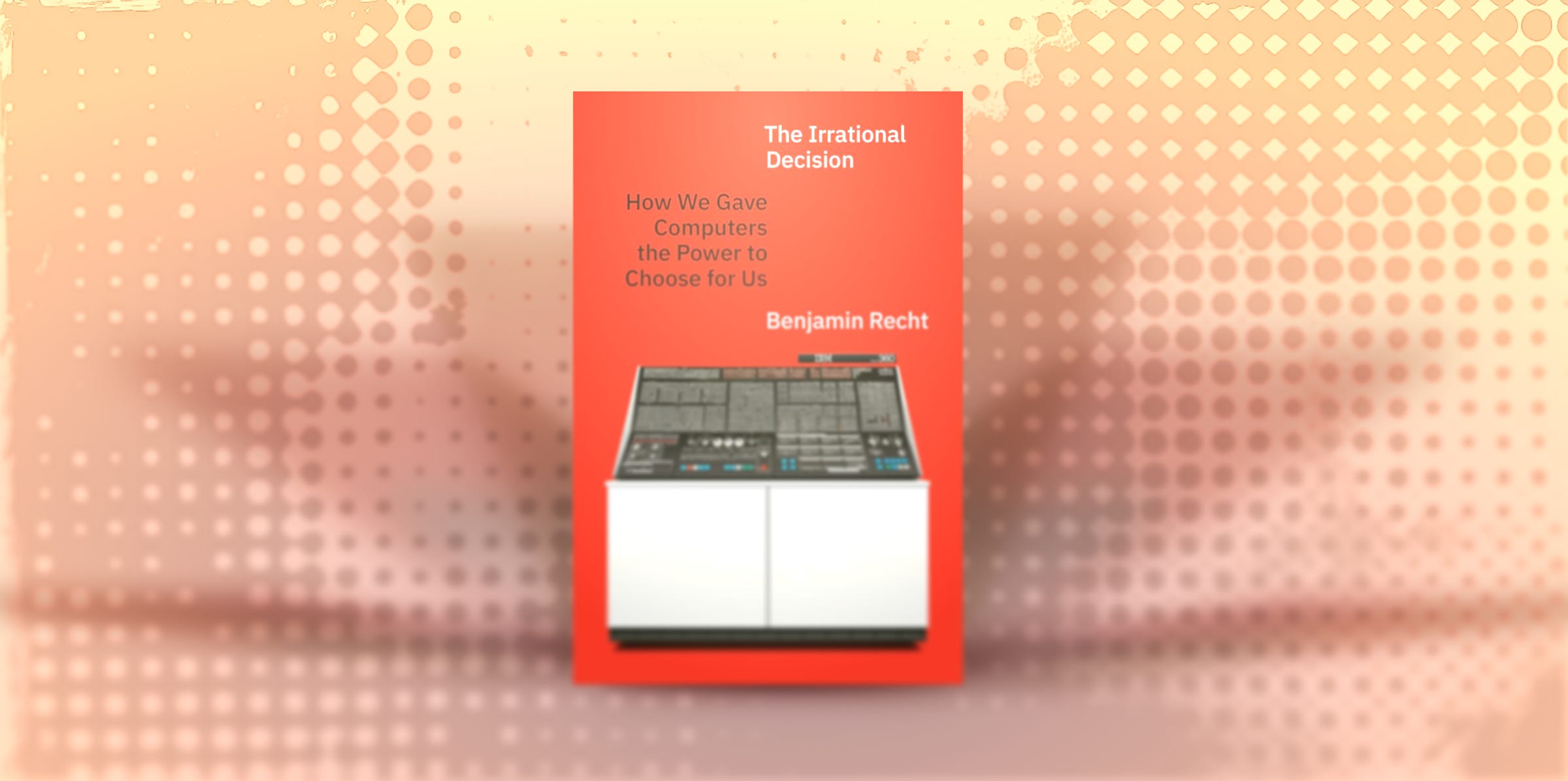
There are, as a general rule, too many books out about AI right now. Yet these books, for all of their variety in tone and orientation towards AI, tend towards a certain sameness in presentation. Whether critical or laudatory in inclination, the current crop of AI books relies on a certain constrained set of historical beats, beginning with brief nods to Claude Shannon and ELIZA in the mid-20th century, passing over a long and mysterious winter, and ending with a hyper-focused portrayal of the technological developments of the past decade and a half. These books remake history into a teleological march to the present day, an obvious path to the status quo. They may answer the who, the what, or the how of our current techno-cultural moment, but they all uniformly fail to grapple with the why.
Ben Recht’s The Irrational Decision is a very different book about artificial intelligence — to whatever extent it is a book about artificial intelligence at all. Recht trains his sights not upon modern technological systems themselves but upon the mathematical, rational governing ideology that led to their creation. In doing so, he guides readers to a deeper understanding of the concept of rationality and how a seemingly simple idea became an organizing logic for much of modern society over the course of the twentieth century.
Recht, a professor in Berkeley’s EECS department (and advisor to Reboot’s very own jessica dai), is not a historian by trade. Yet The Irrational Decision serves as an artfully wrought window into the past in the way the best intellectual histories are, a book that allows you to understand and empathize with the flawed logics of the thinkers of the past even as it ably demonstrates the consequences of their decisions. Recht’s gaze falls upon the obvious precursors of our technological moment, yes, but also hits upon more unexpected paths.
The book’s first few chapters amble through an early exercise in optimization that sought to find the minimum cost diet for Americans during the Great Depression, various attempts to solve poker and other complex games through dynamic programming, and more strange interludes that nevertheless contributed, piecemeal, to advancing the concept of mathematical rationality into more and more arenas of contemporary life. In each of these case studies, Recht identifies triumphs (a diet that could feed an average American for less than $40 per year!) and failings (said diet being composed solely of the perhaps unappetizing combination of flour, evaporated milk, cabbage, spinach, and navy beans) of the mathematically rational approach.
By the time he reaches the origins of pattern recognition in machine learning in Bill Highleyman’s early efforts at optical character recognition in the early 1960s, it’s clear that no aspect of our contemporary world’s focus on mathematically rational process is novel. That’s a throughline in The Irrational Decision: there’s nothing entirely new under the sun. in a footnote, Recht mentions that his own academic work in machine learning was once mocked by Marvin Minsky for being nothing more than a revival of 1930s-era optimization processes. To Recht, contemporary evangelists of outsourcing more and more of human decision-making to putative rational machine intelligences are in a sense just carrying on in a tradition of optimizing logic that has lasted for much of the last century.
In Recht’s telling, mathematical rationality became a dominant worldview through a messy dialectic, the ever-more-sophisticated algorithms and computing hardware of the twentieth century on one side and the ever-widening set of problems researchers set those tools upon on the other. What begins as economists and mathematicians tinkering with rudimentary optimization problems in the age of ENIAC ends, somehow, with Stephen Pinker and Nate Silver preaching the gospel of mathematically rational, probabilistic thinking as a tool for living well and getting rich.
The Irrational Decision is not a polemic against mathematical rationality in all of its forms, but instead a more precise strike against the dominance of the rational worldview. Recht’s argument, at its core, is that mathematical rationality has become an overextended tool, a hammer asked to not just hammer nails but turn screws and saw boards as well. He saves his deepest critique for those who seek to remove human irrationality in its entirety from collective decision-making — those who, in his words, would make us “compute our way to utopia.” In response, he emphasizes that, underneath all of the complex layers of rational computation, any given optimization problem is, ultimately, determined by human choices, in all of their messy, disagreeable irrationality.
The Irrational Decision is out now from Princeton University Press. Join us on Tuesday March 17 for a discussion in San Francisco with Ben Recht about the book.

Reboot publishes essays, interviews, and book reviews by and for technologists. Subscribe for more like this!
🌀 microdoses
In another world, perhaps our data-driven visions of society would look a little more like the early-Turkish-republican data visualizations Elizabeth Goodspeed dug up:


New massive set of scientific retractions just dropped.
Gareth Fearn on the struggles of the age of transition between fossil capital and electro-capital.
David Oks on the struggles of the age of transition between bank tellers, ATMs, and iPhones (and its implications for how AI automation of labor may play out)
The third issue of the SF Review of Whatever is out now! It’s very fun.


💝 closing note
Regardless of what I said up there about there being too many AI books, I’m still interested in what the big tech/literary stories of the year are; if there are books we should be reviewing or stories we should be covering, let us know!
— Jacob & the Reboot Team
This sounds fascinating. Thanks for convening and sharing - I'll feature in next week's issue!
Thanks for sharing my newsletter! <3