


Kernel Magazine Issue 6 is out now! We’re sharing another piece from the issue — Alex Wennerberg’s examination of what it means to take shrimp welfare seriously, both in terms of hard moral calculus and fuzzier feelings of care. If you were at the Kernel Launch in SF last week, you got a sneak preview of this piece! For the rest of you: get your copy of the magazine now!
—Jacob Sujin Kuppermann

🌽 Who Cares About the Shrimp? 🔩
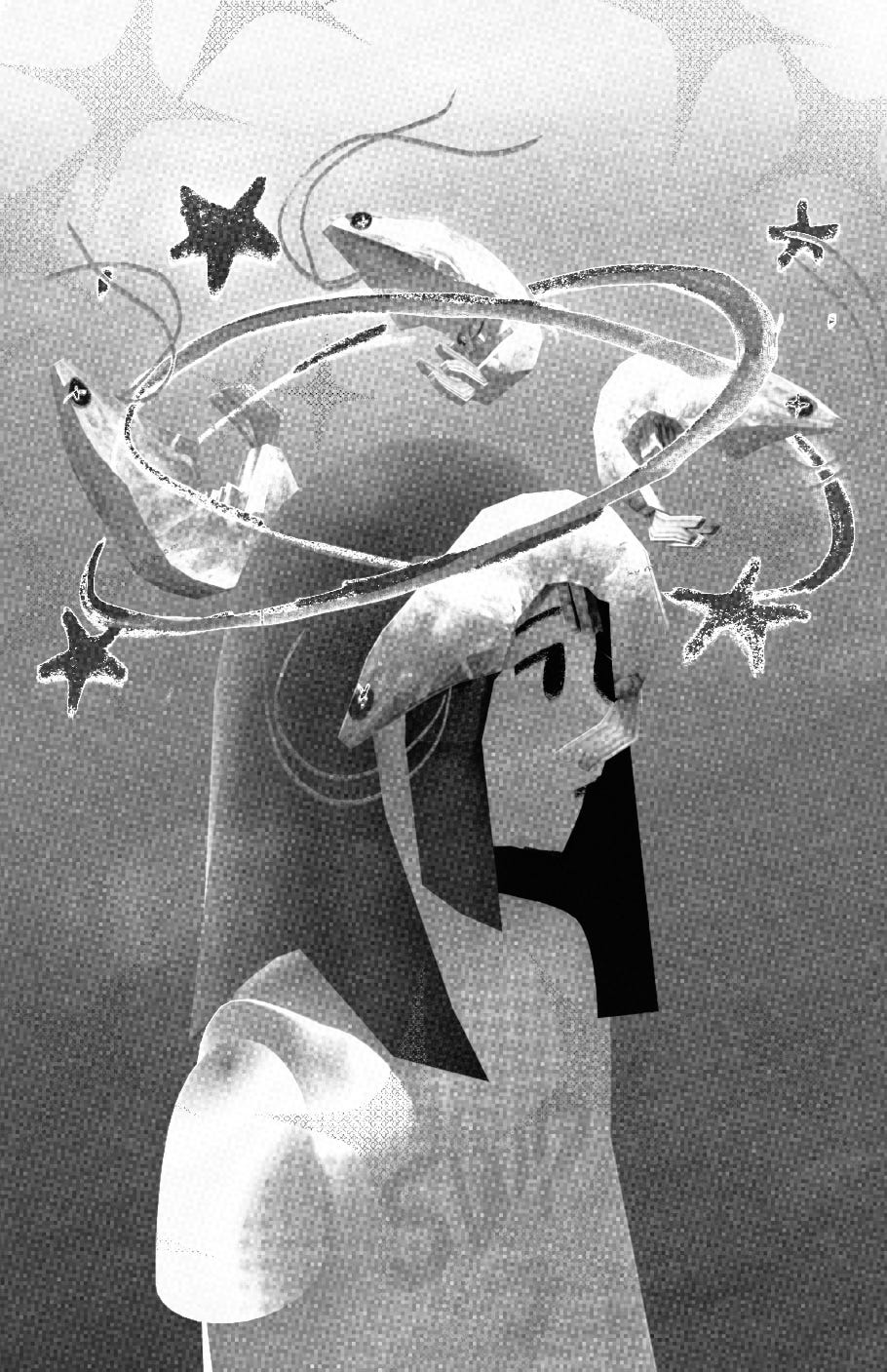
Edited by Sonja Belkin
The more “humane” method of killing shrimp on farms is known as “ice slurry immersion.” Submerged in icy water, the shrimp are induced into thermal shock — slowing down their nervous system as they freeze to death. In practice, the evidence that this is a “painless” death is mixed, and slurry immersion is performed inconsistently: the water is often not cold enough, leaving shrimp to die by crushing or asphyxiation instead. Often, this process is skipped entirely, with shrimp left out in open air, suffocating over the course of twenty minutes to an hour.
Shrimp farming is a relatively new phenomenon. Developed in the 1930s by researcher Motosaku Fujinaga, the first large-scale commercial farms emerged in Japan in the 1970s, as demand began to outstrip supply of wild shrimp. Aquaculture only became the primary source of shrimp produced worldwide in the last twenty years and now accounts for the vast majority of shrimp consumed in the United States. In industry, shrimp production is measured in tonnage, rather than number of deaths, which is around 440 billion per year: more than all other farmed animals combined.
This estimate comes from Shrimp Welfare Project (SWP). Founded in 2019 by Aaron Boddy and Andrés Jiménez Zorrilla, it is the only organization dedicated specifically to promoting the welfare of various species of farmed shrimp and prawns. The primary activity of Shrimp Welfare Project, and what they refer to when they state that each dollar helps 1,500 shrimp, is their Humane Slaughter Initiative: the production and distribution of large electric stunners to farms, for free. These large metal boxes, as opposed to other slaughter methods, use electric shocks to render shrimp unconscious before their deaths. 100 million shrimp go through a single “el-stunner” each year, receiving a comparably painless death.

For decades, similar initiatives have existed for farmed land animals such as chickens, cows, and pigs; their lives may be relatively miserable, but, by law in many countries, their deaths should not be. Shrimp Welfare Project, motivated by advocacy, rather than compliance, is a “welfarist” animal rights organization that works collaboratively with shrimp farms, rather than against them. Indeed, as aquaculture technologist Shannon Roberts says in a promotional video for the Optimar Electric Stunner, welfare researchers and industry are “working towards the same values, with the same goals.” For Shrimp Welfare Project, the goal is an aggregate reduction in global suffering among sentient life — suffering which is exceptionally concentrated in farmed shrimp.
Impartial Welfare Maximization
When discussing animal welfare, philosopher Peter Singer introduces the concept of the “moral circle” — the collection of entities (human and otherwise) that are worthy of our moral consideration. Believing that certain animals deserve a humane death and, more broadly, that their welfare matters means that we treat them as being within this circle. Shrimp Welfare Project calls on us to expand our circle to include shrimp — small creatures whose experience is quite alien to our own. This call to trouble ourselves with an animal as “marginal” as the shrimp has its roots in the thinking and community of effective altruism.
Inspired by utilitarian ethicists, including Singer, effective altruism, or EA, emerged in the late 2000s, establishing an ecosystem of nonprofits and research organizations designed to, in their coinage, “do good better”. Although within EA there is diversity of thought — indeed, EA is not in itself a comprehensive philosophical system and the community’s beliefs can be difficult to pin down — the general shared notion of “good” and “better” is well conceptualised by EA philosopher William MacAskill in his description of “impartial welfare maximization.” For EAs, our moral system should aspire to be impartial — with no bias towards those closer to us in time, place, or species — and our definition of “good” should be “welfare” — positive feelings and the absence of negative feelings among sentient life — which ought to be quantified and maximized.
Shrimp Welfare Project explicitly acknowledges the influence of EA principles on their work, with its founders citing EA organization Rethink Priorities’ 2019 Invertebrate welfare cause profile as the inspiration for their work. EA has also supported the organisation materially: in 2021, Boddy and Zorrilla received a seed grant from the EA “incubator” Charity Entrepreneurship. Consequently, it is within the context of effective altruism that the activity and priorities of this organization can be understood — the expansion of the moral circle to include shrimp as well as the particular focus on the magnitude and quantity of shrimp suffering. Indeed, the numerical language of EA pervades SWP documents: the number of shrimp killed per year (440 billion), the number of shrimp helped per dollar (1500), the total number of shrimp humanely slaughtered (5.5 billion) and so on. In Boddy and Zorrilla’s telling, while they were broadly concerned with animal welfare, they had little particular interest or attachment to shrimp before being exposed to EA research. Rather, shrimp welfare was a cause whose importance was established solely by asking: “where is the most suffering that is happening in the world, that can be ameliorated with the lowest cost?”
One shared social principle described by the effective altruist community is that of “scout mindset”; rather than relying on conventional morality, exploratory “scouts” should aspire to patiently, deliberately, and curiously consider new ideas which may challenge conventionally held beliefs. As a result, EAs often draw out strange and counter-intuitive implications from their principles. On the more mainstream end, EA-funded charity evaluator GiveWell has extensively prioritized donations to charities which distribute insecticide-treated anti-malaria nets or Vitamin A tablets to low-income countries. Yet taking EA thinking further can also lead to the contemplation of stranger ideas, such as whether these nets may have a net negative impact on aggregate welfare due to their harms to mosquitos, whether the moral value of future life far outweighs that of the present, whether AI chatbots may possess morally relevant “digital sentience,” or whether we should consider measuring welfare across all universes in the multiverse. Shrimp welfare is probably somewhere in the middle — immediately odd and unfamiliar, but, as portrayed by The Daily Show’s segment on the subject, reasonably acceptable after one hears an extended pitch. For many people, shrimp may be positioned just at the edge of their moral circle — hence, their inclusion is negotiable. They push the boundaries of animals that we think are worthy of our consideration, but not as much as, say, more fringe EA advocacy for creatures such as insects, soil nematodes, or micro-organisms. As such, shrimp are in many ways a model moral organism.
To evaluate the importance of a cause, EAs commonly use the ITN framework, which scores issues on three metrics: importance (the value of solving it), tractability (how solvable it is), and neglectedness (whether anyone is solving it). Shrimp welfare comes in extremely high on all three: the number of farmed shrimp is enormous, they suffer terrible conditions that can be improved at relatively low cost, and, as Zorrilla said to Current Affairs, “[e]ssentially no more than maybe one or two, if any, people in the whole world were trying to improve the situation.” This ultimately leads to an extremely high measurement of effectiveness in terms of “good done per extra dollar.” By their estimation, Shrimp Welfare Project has provided 5.5 billion shrimp per year with a comparatively painless death, among other welfare initiatives, for a relatively low cost of about $2.5 million in total organizational expenditures from 2022 through 2025.
Many effective altruists interested in animal welfare reject “hierarchicalism” — the idea that the human experience is more important simply because of its human-ness. This doesn’t mean that the suffering of an individual human and individual animal suffering is equally important, because humans, with their more complex nervous systems, are capable of more sophisticated and subtle forms of experience. Rather, it means that human and animal welfare are exchangeable via some measurable rate. If we accept Bob Fischer’s estimate for Rethink Priorities, a shrimp is capable of 3.1% of the positive and negative “valence” (capacity for affect) of a human being. In other words, there is a number at which human and shrimp suffering can be compared. Instead of the industry’s shrimp “tonnage”, in this strict interpretation, effective altruists conceive of shrimp as enormous masses of “utils” — positively-or-negatively-valenced experiences which we can weigh our moral judgments against.
Some EA writers have used this reasoning to weigh the plight of the shrimp and SWP’s importance much higher than those involved with the project itself. As Robin Goist, director of communications at Shrimp Welfare Project, told me, “it just intuitively does not feel or sound good that a certain number of shrimps would be equal to or more important than a human life like that, so that’s not really the argument that we are making.”
On the other hand, Substack writer Matthew Adelstein, who helped lead $15,000 in contributions to Shrimp Welfare Project, has no such qualms drawing out the numerical implications of Fischer’s research: “a dollar given to the Shrimp Welfare Project prevents as much agony as anesthetizing 46.5 humans before they slowly suffocate to death at low temperatures, per year!” In a similar vein, Vasco Grilo, a popular writer on the Effective Altruism Forum, estimates that Shrimp Welfare Project is 139 times as effective as the second-most-effective animal-targeted charity, and 64.3 thousand times more effective than the most effective human-targeted charity. The implication is that farmed shrimp suffering, with its staggering hundreds of billions of preventable painful deaths, is perhaps the most important cause and Shrimp Welfare Project the most effective charity — in the world. As Adelstein writes, donating to Shrimp Welfare Project “is a truly absurd amount of good—much more, per dollar per year, than every nice thing I’ve ever done interpersonally.” Put another way, in this view, one could say that every act of good I have ever done in my entire life, every kindness I’ve shown to a friend or stranger, every time I’ve helped out someone in need, every time I’ve shown compassion towards a friend or loved one, or even my decade of vegetarianism, pales in comparison to the moral weight of a single $1,000 donation to the Shrimp Welfare Project. If God is a strict utilitarian, heaven is populated entirely by SWP contributors.
Such a claim may stretch our moral intuitions. Still, to think like an EA, we should recall “scout mindset”: our intuitions often lead us astray, compelling us to unreflectively give the bulk of our charitable contributions to organizations like university endowments, food banks, or animal shelters, all of which are not very “effective” in terms of “good done per extra dollar.” In order to “do good better” we must reject our intuitions, free ourselves from personal biases, and consider things in a framework of pure, calculating reason. Only once we see things clearly can we properly assess the magnitude of the issues at hand.
Swedish philosopher Nick Bostrom, popular among effective altruists concerned with AI safety, considers the thought experiment of a “paperclip maximizer.” Imagine an AI whose directive is to make as many paperclips as efficiently as possible. Given sufficient capabilities, it would soon come to the conclusion that humans, the world, and ultimately, all matter in the universe should be transformed into a static mass of paperclips. This is, of course, a cautionary tale about aligning AI to human interests. It is striking, however, how closely this resembles the effective altruist view of suffering. Effective altruists on the more radical end have created their own kind of paperclip maximizer — sacrificing all non-instrumental, non-quantifiable aspects of life, relationships, nature, beauty, love on the altar of abstract, quantifiable pleasure and suffering. Instead of paperclips, they transform the universe into “utils.” As philosopher Roger Scrutan writes: “All is swept into a corner by the great broom of utilitarian reasoning, to be left there in a heap of dust.”
It is probably a minority position within the effective altruist community to take the consideration of animal welfare to its logical extremes or to consider utilitarianism as a totalizing ethical system. For example, Giving What You Can’s 10% pledge suggests contributing a bounded one-tenth of your income to effective charities. Ironically, the enormity of shrimp suffering and focus on the extraordinary “effectiveness” of SWP’s interventions can diminish the consideration of radical personal or societal changes such as vegetarianism or an abolition of shrimp aquaculture. Advocacy for those changes has a much more uncertain measurable impact than a much more reliable modest recurring monthly nonprofit donation (this is how Adelstein, for example, measures success). SWP is even used by some to wipe clean any sense of guilt around personal meat consumption: using FarmKind’s Compassion Calculator, one can determine how much it would cost to offset the moral damage of their meat-based diet with contributions to animal welfare charities, including Shrimp Welfare Project ($23 per month for the typical meat-eater, 33 cents for a vegetarian). For high earners, this may be easier to stomach than a change in eating behaviors.
Our unsettling encounter with an incomprehensible mass of suffering thus becomes sublimated by the EA framework into effectiveness. In doing so, EA’s singular focus undermines its own radical potential — that of a deeper reconsideration of our relationship, both personal and social, towards animal life.
Caring for Shrimp
Effective altruists’ concern for animal life, especially at the margins, is a genuinely bold counter to conventional moral attitudes towards animals. Despite personal diet changes not being the primary goal of their animal advocacy, in a 2019 survey, a wildly disproportionate 46% of effective altruists identified as vegetarian or vegan (compared to 5% of Americans). Two aspects constitute effective altruists’ consideration of animals: the expansion of the moral circle to include these creatures and the understanding of their welfare in the broader project of “impartial welfare maximization.” However, there is an alternative way to “expand our moral circle” to include animals — as an ethics of care: a softer, more personal relationship of compassion towards animals as creatures that are like us, that we live among.
Despite its EA origins, Shrimp Welfare Project contains within it this softer attitude towards shrimp, who are portrayed by SWP as uniquely delicate, and, as WP’s Lien Huong Trin describes them, “voiceless and often ignored” creatures. On Instagram, SWP runs a weekly “shrimp meme Saturday,” sharing light-hearted pictures and cartoons of shrimp. Zorrilla reports that, despite originally approaching the shrimp dispassionately, encountering the conditions on shrimp farms led him to develop a deep compassion for them.
Aaron Boddy (who is vegan) recently blogged about a moral struggle he had with getting his landlord to kill wasps in his apartment building for the Effective Altruism forums:
I do think killing the nest is probably the right call. But I’m deeply uncomfortable with that conclusion. Which feels absurd, given that my work is literally to help kill animals better. And yet here I am, agonising over wasps.
This is, of course, not effective altruism — establishment and support of results-driven organizations dedicated to the impartial welfare maximization. It is rather a felt sense of care for animal life — a two-way encounter, a comprehension of the difficulties of living well alongside animals. Wasps, even more so than shrimp, test the bounds of our moral circles.
Eliezer Yudkowsky, founder of the EA-adjacent forum LessWrong, derisively calls this kind of empathy “warm fuzzies” — softer, maybe even selfish feelings of moral goodness based on personal feelings, rather than the rational calculation of “effectiveness.” However, dismissing these intuitive sensibilities ignores that they are foundational to establishing a moral world. In a UK government commissioned report, led by Prof. Jonathan Birch and cited by SWP as evidence of shrimp sentience, the researchers write:
Everyone agrees, for example, that it is wrong to treat a dog as if it had no interest in shelter, food, water, and comfort. If some invertebrates [such as shrimp] are sentient, then it is also wrong to treat them in a way that shows inadequate consideration for their interests.
“Everyone agrees,” the philosophical foundation upon which the inclusion of shrimp within our moral circle is established, appeals to our intuition. It is already obviously true, in places like the United Kingdom, that dogs, like people, are sentient, because we live around them, beside them, in relation to them as companions. To consider their existence as morally worthwhile does not appear to require scientific research. For animals like shrimp, however, there is no such assumption of their moral worth, which must be proven through these “sentience studies.”
The skepticism some of us may have towards shrimp sentience is likely the result of never having encountered a live shrimp — and certainly not a wild one. Shrimp farming happens thousands of miles away, performed by people whose lives may appear very foreign to our own. Yet, shrimp farmers — perhaps surprisingly — report a much higher confidence that these animals “feel pain.” As Robin Goist told me, SWP’s understanding of shrimp sentience also comes from the organization’s field work, of seeing shrimp “eye-to-eye”: “You can just sort of tell if they are feeling pain or distress,” she said.
A particular practice Shrimp Welfare Project highlights and seeks to abolish is known as eyestalk ablation. Early research into shrimp aquaculture discovered that breeders can artificially increase a female shrimp’s egg production by crushing one of its eyeballs. This has since become standard practice on shrimp farms. Zorrilla notes that this practice, more so than any other highlighted by Shrimp Welfare Project, elicits a visceral response. At stake here is not just pain and suffering, but the dignity of shrimp. It may be difficult for us to feel what it is like to be a shrimp by looking at its expressionless face, or by reading a lengthy scientific report about potential animal sentience. But by imagining, as depicted by Hong Kong comic artist Joan Chan, a shrimp crying, “What are you doing to my eye?”, we can conceive of what it might feel like to be in a strange, alien environment, subject to senseless cruelty beyond our comprehension. Maybe shrimp don’t experience this in those exact terms, but in some deeper empathic sense, which can’t be quite established by sentience studies, I feel that a shrimp, split off millions of years ago from my ancestors on the evolutionary tree, still shares with me some essential animal nature, and in an inarticulable way, feels something like it.


French philosopher Maurice Merleau-Ponty describes this shared element that perceiving subjects inhabit as “flesh.” In his telling, it is not our “inner sentience” through which we come to understand one another, but rather our shared, bodily experience of the world. Viewing other species as “philosophical zombies” that behave as robotic automatons rather than living beings, artificially tears us from the essential relations with human and animal life that we are “always already” entangled within. In other words, empathetic “fuzzies” are more real, more essential to building an ethical world, than “utils.”
The implication of a broader ethic of “care” — of the consideration of shrimp as beings fundamentally like us, sharing our world — breaks out of the narrow “welfarist” vision of shrimp as vessels for good and bad feelings. Instead, we can begin to conceive of shrimp as possessing their own “shrimp world.” In Merleau-Ponty’s reading of biologist Jacob von Uexküll, animals, like humans, should be understood not as possessing private sentience, but rather an inseparable Umwelt (environment, literally: around-world), in which their sensitive faculties have co-emerged. Their “worlds of meaning” are an essential part of themselves, and are something to them — even in the so-called “lower” animals like the shrimp.
This philosophy may lead us to consider forms of violence not fully articulable in an EA framework of suffering and pleasure. As philosopher Zipporah Weisberg writes:
We might think of an orca removed from the ocean amongst its pod, and placed in a foreign environment, say a small tank at a water park. The orca continues to have a mysterious relation with its new Umwelt, but the relationship is inevitably hostile, dysfunctional, and a source of misery.
The ethical implications of this for shrimp farming are clear: the issue is not merely that farmed shrimp suffer terrible conditions of “negative valence” — although, as SWP has thoroughly demonstrated, they absolutely do. It is that the act of tearing a shrimp from its natural home and placing it in an artificial environment is itself concerning. A shrimp may suffer less on an ideal Shrimp Welfare Project designed farm, but it is still in some sense alienated, less “itself.” Foreign to the effective altruist vision of welfare is an understanding of human psychology that places meaning, rather than pleasure or suffering, at the center of well-being — and that shrimp, too, are in some sense embedded in meaningful natural relationships.
With Shrimp Welfare Project, the primary expression of kindness towards shrimp remains narrow, limited by the bounds of effective altruist thought and the compromises of running a welfarist organization. Yet, the organization contains within it a kernel of deep, felt care, of recognition and respect for an animal so strange and different from ourselves, and a desire to give them a less painful exit from this world. Immersing myself, as SWP does, in shrimp life, these animals have become not just objects of consideration, but agents in their own right, whose behavior, desires, and so on, have seeped their way into my consciousness.
“Someone once asked me for cute shrimp pictures, and I sent them a few,” Jiménez Zorrilla told Current Affairs, “and they responded, ‘Well, clearly, you’ve been at this for way too long.’” But after spending so much time learning about the world of shrimp in a much smaller, briefer way that he has, I get it — these really are delicate, beautiful creatures.
While SWP focuses on the most commonly-farmed species of shrimp — namely, the whiteleg shrimp and giant tiger prawn — for $55 (or the cost of helping 82,500 shrimp), I was able to see several more aesthetically interesting species at the California Academy of Sciences: from the Randall’s pistol shrimp, which, mostly blind, relies on a companion fish to navigate, to the larger sugar cane shrimp, which seemed to struggle against its confinement, clinging to the aquarium tank’s blank white walls. The most animated shrimp, and my favorite, were the crystal backwater shrimp, who industriously cleaned small flakes off their enclosure floor and occasionally paused to look back at me. It’s difficult to understand how they might feel about their condition — confined to small enclosures, poked and prodded by noisy children, and occasionally, strange onlookers such as myself. I spent about forty minutes with a dozen or so shrimp, and I may be biased from fifteen years of vegetarianism, but certainly on this point I agree with Shrimp Welfare Project: that every animal I saw looked like it was worthy of a life of dignity, autonomy, and care.
Alex Wennerberg is a tech worker and writer living in beautiful San Francisco, California.
Sonja Belkin is a PhD candidate at the London School of Economics, where she studies how LLMs may threaten epistemic security. Her broader research interests lie at the intersection of cognitive psychology, technology, and security, particularly how to design and regulate information ecosystems to make them resilient to AI-driven manipulation.
Thanks for reading — if you enjoyed this essay, we’d really appreciate it if you shared or forwarded to a friend!

personal impact statement: i thought about getting a shrimp burrito today but did not on account of this piece
I LOVE SHRIMP!