


Kernel Magazine Issue 6 is out now! Tonight, in Toronto, Justin Lin will be reading from this piece on his time working at a factory that makes generic-brand Uncrustables at the Kernel 6 Toronto Launch Party! For the rest of you: get your copy of the magazine now!
—Jacob Sujin Kuppermann

🌽 What Makes The Sandwich Special 🔩
By Justin Lin
Edited by Jacob Sujin Kuppermann
Making a peanut butter and jelly sandwich seems like one of the simplest tasks imaginable: two slices of bread, a layer of peanut butter, a spread of jam, and within minutes you have the perfect quick snack. Yet that same straightforward process becomes remarkably complex when you have to produce millions of identical PB&J sandwiches.
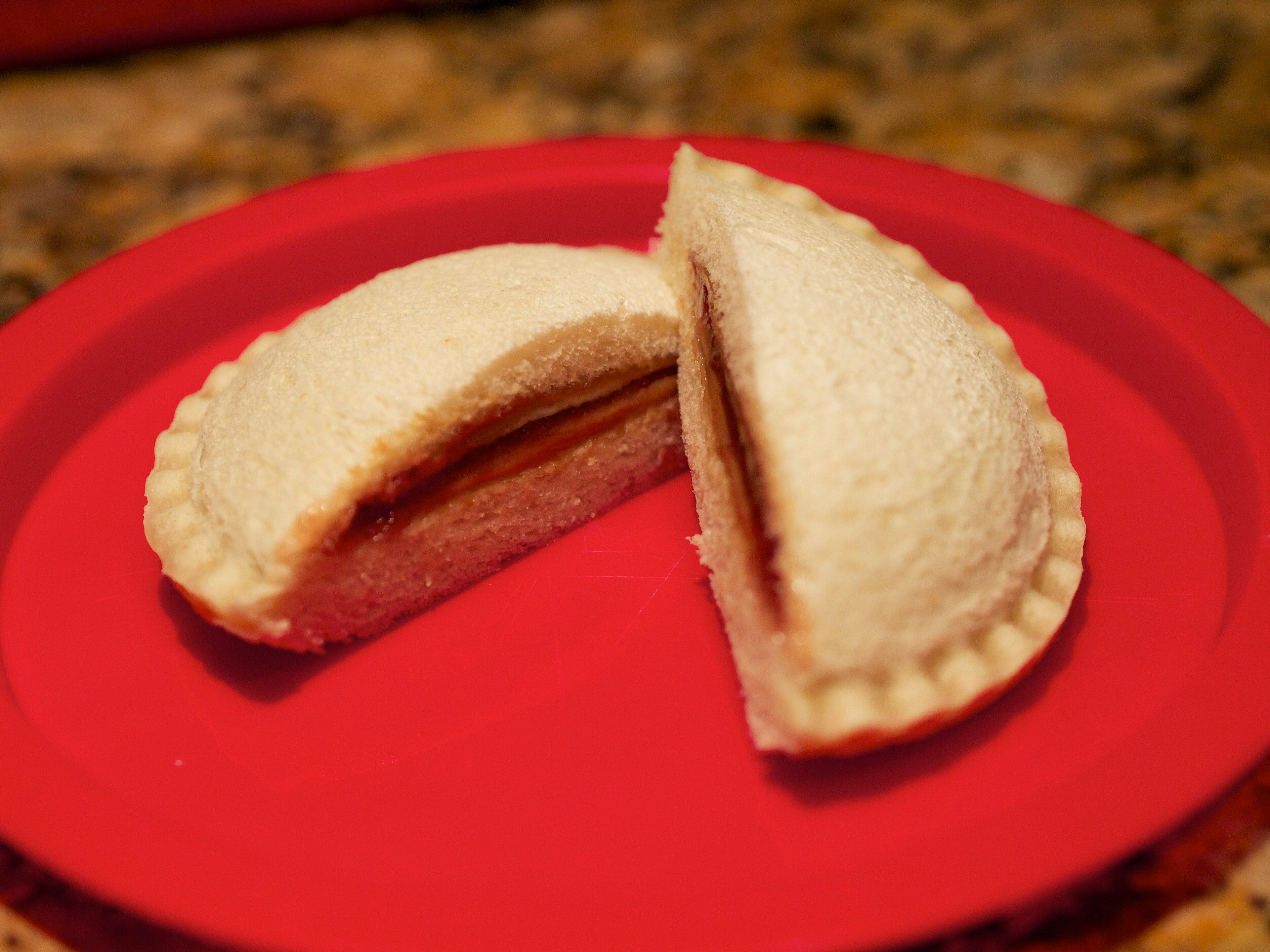
America is fascinated by ‘frozen sealed crustless sandwiches.’ These convenient snacks are sandwiches filled with peanut butter and jam, packaged individually, and, perhaps most iconically, with the bread crusts removed. The ‘Uncrustables’ brand, which originated the form in 1995, leads the market with over 1.5 Billion produced annually. Their success has led to multiple not-quite-as-memorable knock-offs: spinoffs such as Trader Joe’s Crustless Sandwiches, Kroger brand Crustless, and Charlotte’s CrustOffs. These brands all focus on convenience and mass production to appeal to consumers, and maybe capture the nostalgia of a simpler time from childhood. When I walk through the frozen section in a grocery store, I always stop and smile, knowing that, in a small way, I played a part in making these sandwiches.
Just as a chef cooks in a kitchen, or an artist paints in a studio, the factory acts as a canvas where different trades display their craftsmanship.
I work at the crustless sandwich factory. When I first walked through it, I was astonished at the sheer scale at work. Shelves that reached the ceiling lined with mountains of sugar and thousands of barrels of jam and peanut butter, forklifts zooming back and forth from the cave-like freezer to load the rows of transport trucks. I remember being mesmerized by the flood of frozen sandwiches being whisked around on conveyor belts. It was then that I realized that I was in a place beyond basic construction and had transitioned into the world of automation and controls, with state of the art factory equipment that demands trades from many fields. I quickly learned that the factory is a unique place. Just as a chef cooks in a kitchen, or an artist paints in a studio, the factory acts as a canvas where different trades display their craftsmanship.
I am an electrician by trade. Throughout my career, I have wired residential homes, serviced homes and commercial buildings, been a foreman for countless new constructions, worked on high-rises, and most recently, started working as a subcontractor for industrial bakeries. This work is completely different from any other facet of the electrical industry. For traditional construction projects, once the build is complete, your job is done. In the industrial sector, however, even after the facility is built, you will keep returning to maintain and add new things to the facility. Today, I work alongside many talented tradespeople who specialize in engineering, HVAC, plumbing, electrical, fabrication, and systems integration. Through the years you end up building a long term relationship with the people, machines, and systems in the factory and growing together in your skill and experience.
So, what does it take to make a PB&J?
* * * * *
The factory where I work produces more than 300 000 sandwiches every day. To achieve this takes many small improvements and process optimizations. To make the bread required for all the sandwiches, we start at the heart of the operation in the mixing room: a massive chamber, webbed with pipes and conveyors all feeding into the dough mixer. The mixer is a beast, a machine the size of a small dump truck that thumps rhythmically as the dough within is churned. Above the mixer, there are a series of hoppers filled with ingredients like salt, sugar, and ice ready to be precisely dispensed. Load cells on the hoppers measure the weight of the ingredients being dispensed, while fill level sensors monitor when the hopper is full. Every machine in the factory is governed by a control cabinet which houses a Programmable Logic Controller (PLC), circuit breakers and fuses for protection, terminal blocks for wiring, motor drives and contactors, and many other essential components. The factory is consistently being improved and as an industrial electrician, I have to rewire, add, and update hardware in each cabinet as things change. For example, the hopper fill level sensors were originally ultrasonic sensors, but due to the vibration from the mixers, they gave false readings and had to be changed to more reliable radar sensors. Although the factory is vast, some control cabinets are physically interconnected with communication wires to ensure coordination of production. For instance, when the mixer needs more flour, the mixer control cabinet sends a signal to the silo cabinet across the factory and flour is blown through a series of stainless steel pipes to fill the hoppers. This complex interconnection extends to the smallest parts of the system, so protecting the electrical system is paramount. For example, all the tray cables used for the motors and sensors around the silos are ‘shielded’-type cables to prevent any static charge from the flowing flour to disrupt any electronics.
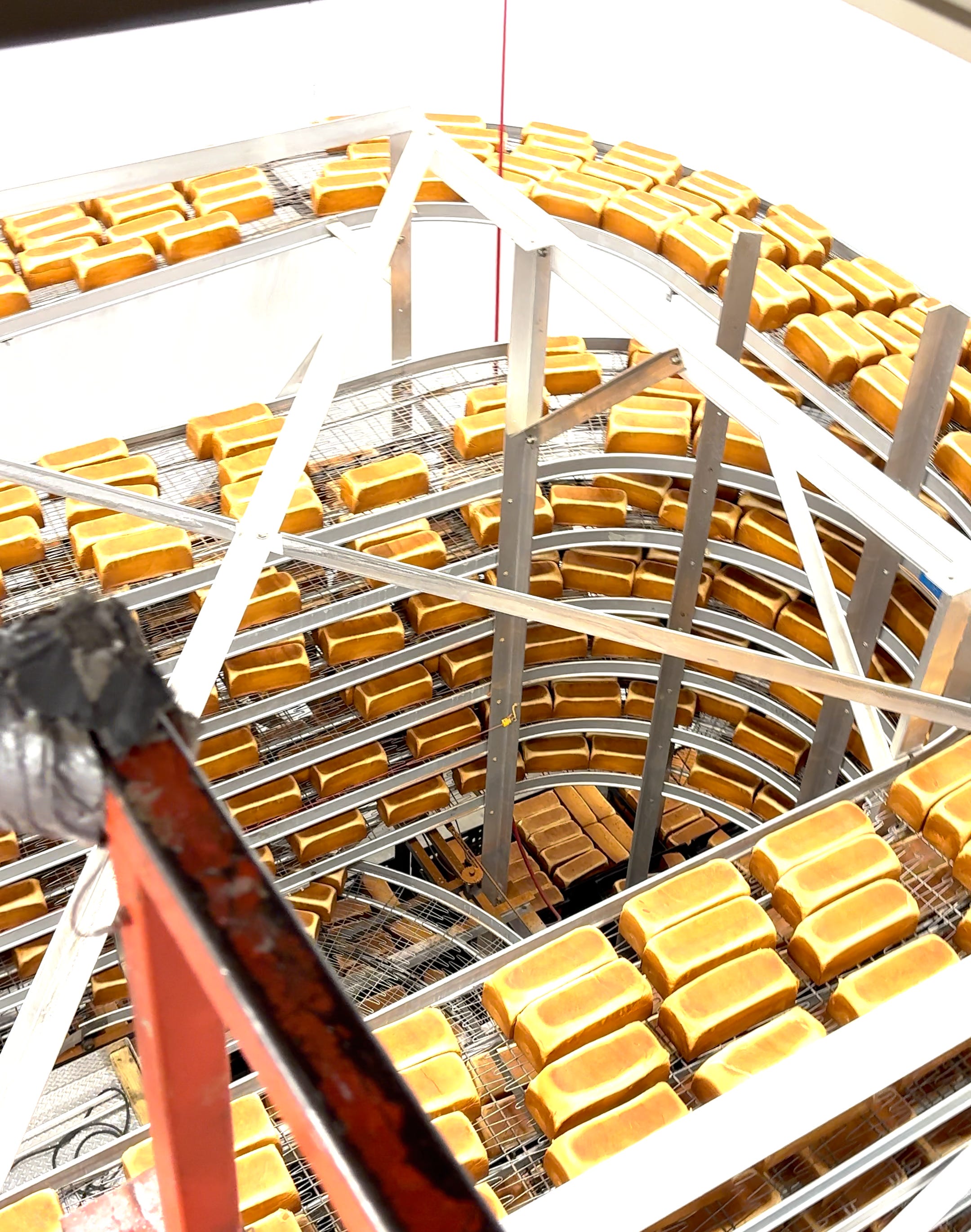
After the dough is fully mixed, it is automatically portioned, rolled, and whisked away by a fast flowing river of conveyor belts. From there, they are dropped into large pans that ride through the warm and moist proofer. After rising, they proceed into the volcano-like oven, where they awaken as fragrant loaves. The loaves barely get a moment together before they are herded into the cooling spiral: a multi-tiered racetrack totalling over 800ft, where they are cooled by fans, before their final destiny.
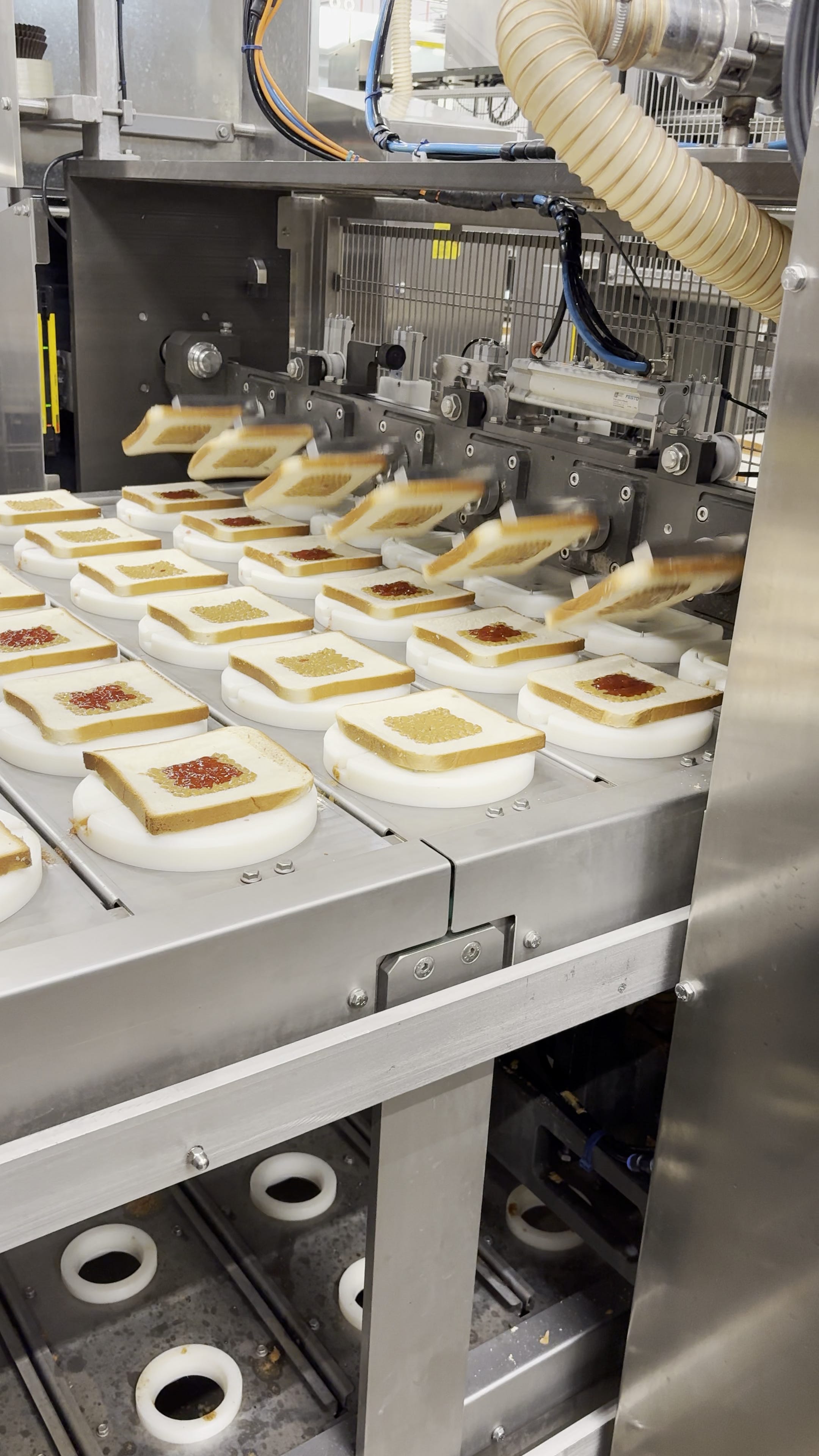
The last steps are performed at rows of bread lines. A series of machines transforms the loaves into crustless sandwiches. Completely autonomously, the loaves are sliced and aligned on a conveyor belt. Next, the system portions the perfect amount of jam and jelly onto every other slice. The machine gracefully flips one slice atop the other. The final step is the most iconic: the crusts are removed by a pneumatic press and the crustless sandwiches are plucked from within the center of the slices. The freshly stripped sandwiches are whisked away to a flash freezer and subsequently packaged. At home, it takes less than two minutes to whip up a PB and J sandwich for yourself, but to produce millions of perfectly identical sandwiches, it takes a complex interwoven system that must work harmoniously to keep the sandwiches flowing.
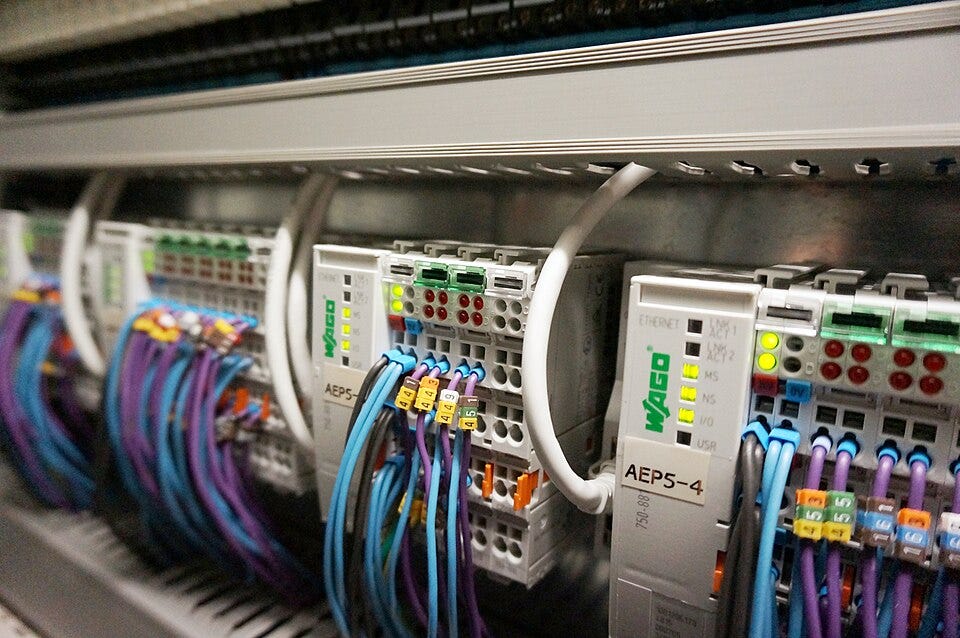
A key tool that organizes the flow of sandwiches is the Programmable Logic Controller (PLC). Introduced in the 1970s, these industrial computers have created a unique niche for people to specialize in. PLCs take inputs from various sensors throughout the system and execute a program to determine an outcome. The outputs are executed in real time and can communicate with rooftop units (RTUs) and other control cabinets, control motors, valves, actuators—anything that is necessary for a particular task. PLCs programs are deterministic, meaning that one set of inputs will always produce a set of known outputs– ideal for tasks that need to be done millions of times. PLC Programmers (better known as systems integrators) are highly skilled; their work sits at the intersection of software, electrical systems, and physical processes, and all three have to align in real-time.
Walking through the factory floor, you are surrounded by an impressive array of food production equipment from many different parts of the globe like Italy, Turkey, China, Switzerland, and Germany. When new equipment arrives, I get the opportunity to work with integrators from other countries to commission the equipment. Implementation can take anywhere from one week to months. The equipment comes like an IKEA set, and with a lot of coordination it comes together piece by piece. As an electrician, I support systems integrators by doing the physical wiring around the machine, running hundreds of shielded or unshielded cables through basket trays to sensors, motors, pumps, solenoids, and signal lights. Millwrights help us fabricate custom mounts for junction boxes and electrical cabinets. Plumbers weld stainless steel piping to transfer liquids around the system, and HVAC use cranes to put RTUs on the roof if we need any cooling processes. After every new installation, which can sometimes take months of planning and preparation, I cannot help but take a moment and feel awestruck by the sheer amount of effort and specialized labour that it actually takes to create things– and all for something as simple as a PB&J sandwich.
* * * * *
On first impression, a factory is a place where you might think technology will replace humans, but I find that it is actually the perfect environment for specialized human labor to thrive. As technology becomes increasingly complex, the premium on experts from around the globe will only grow. And just as sandwiches evolved to have their crusts removed, people will evolve to fill the unique niches that technology brings.
IN THE FACTORY, YOU ARE FORCED TO BE GENUINE
Everything is pushed to its limits in the factory. Buttons are pressed hundreds of thousands of times and eventually get so worn out that they literally fall apart. Gears are ground to dust, and motors run until they give out a puff of magic black smoke. Keeping a factory running is a Sisyphean task. It takes an army of sanitation crews, maintenance workers, and skilled tradespeople to keep the line moving. Whenever I troubleshoot any electrical system, I follow the same cyclical procedure: checking for voltage at the start of the source, then at the problem, and after the issue, systematically narrowing down the bug. Frustratingly, sometimes it’s something as small as a terminal screw not being tightened all the way down, creating a loose connection. After every battle and tiny nuance, I learn and understand the system a little better. The expertise gained through this experience is hard earned. You can’t guess or hallucinate an answer—there isn’t a chatbot to consult or glasses to display the solution.
On many of the systems in the electrical cabinets, there are odometers that record the number of hours the system has run in its lifetime. I always love checking a machine I haven’t been to in a while, and am amazed when I see the number in the hundreds of thousands of hours. While the odometers exist for maintenance purposes, they are a sobering reminder that whatever I build is meant to last. In a world of planned obsolescence, it is refreshing to build things for planned permanence. When I build new systems for factories, I take extra care to uphold the highest level of craftsmanship I can. Sometimes that means taking twice as long or even redoing days of work, because everyone knows that it could be something as small as a turn of a screw that brings the entire production to a standstill. The factory manufactures an environment where people are held to a high standard of craftsmanship. Whether it’s the relentlessness of the machines or the emergencies that force you to confront your knowledge – in the factory you are forced to be genuine.
The factory has only one goal: to make as many crustless sandwiches as possible. To accomplish their staggering production, people create advanced equipment and complex systems. This, in turn, entices professionals from many different fields to converge and work together to assemble, fabricate, and troubleshoot these technologies and reach the collective goal. The symbiotic relationship between technology and human improvement is what makes challenging goals possible. Throughout the entire process, it is people who make the sandwich special. I truly believe that human expertise is necessary, and will always be needed, for even the simplest things— like making a sandwich.
Justin Lin is an electrician with hands-on experience installing, troubleshooting, and maintaining electrical systems in industrial and commercial sites.
Jacob Sujin Kuppermann is an ecologist and the editor-in-chief of Kernel Magazine.
Thanks for reading — if you enjoyed this essay, we’d really appreciate it if you shared or forwarded to a friend!

