Kernel Magazine Volume 6 is out now! Thank you to everyone who joined us at our launch party in San Francisco, where you heard Isabel Pabán Freed read the first portion of this essay: a reading of Twitter as novel/carnival/feast, inspired by the late Russian literary critic Mikhail Bakhtin. It was a joy to read and edit; I don’t think we’ve every published anything quite like it. As always, I highly recommend that you read this piece in print — I recently mailed out the first few dozen copies of Kernel (everyone say “thank you USPS media mail”) and am excited to ship out many more!
— Jacob

🌽 Problems For The Online 🔩
Edited by Jacob Sujin Kuppermann
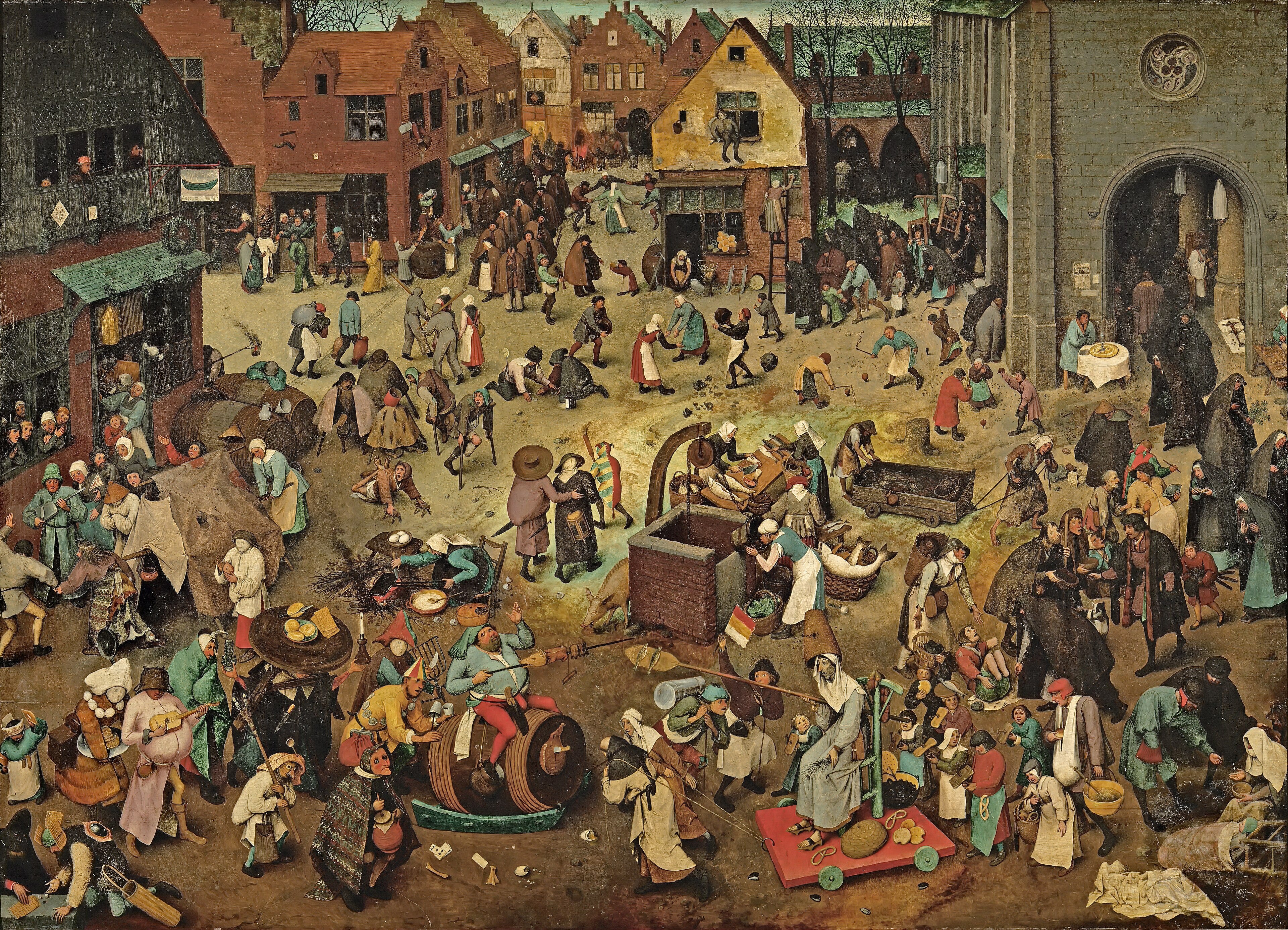
It’s hard to have this fat an ass, some say. It’s harder to have this fat a pussy, others retort. Tits? echoes a chorus in the back. And what of our endowment? wonder the hung. Respectfully, can a young woman possess anything more burdensome than a Rabelaisian disposition? If characterized by a penchant for “scatalogical obscenity . . . curses and oaths, double entendres and vulgar quips,” or a concern with “the lower stratum of the body, the life of the belly and the reproductive organs . . . defecation and copulation, conception, pregnancy, and birth,” or a fondness for “grotesque debasement,” for the “atomization and dismemberment of the human body,” for “exaggeration, hyperbolism, excessiveness,” for “lists,” or indeed for any of the other things Mikhail Bakhtin says in his Rabelais and His World, can one still slay? Girlboss? Can she even serve . . . ?
With quandaries canonical as these, it might be good to eat something first, as it almost never hurts to open a line of philosophical inquiry conscious that your brain is just another part of your “grotesque body,” sharing “its open unfinished nature, its interaction with the world” — you’ve probably eaten before, so you know the procedure: mouth opens; world goes in; mouth, optionally, closes; world gets chewed up, swallowed, digested; sphincters relax; world goes out; brain thinks, ohhhh, okay tea, the “limits between man and the world are erased” and thus my relationship with nature, that thing of which I am both separate and a part, is quite literally metabolic as I eat the literal fruits of my labor, or someone else’s, or maybe even something else besides, and so maybe me, brain, think thusly . . . and yahoo! Look at that: you’ve changed! No longer the Rabelaisian you once were, you are now a newer, different, still-dialectically-sort-of-the-same Rabelaisian with the same body but a different body, the same mind but a different mind, and wouldn’t it be nice and trippy if thinking humanistically worked this way, too, with ideas shitting and sweating and having noses that could blow, drool that could drool, piss a-pissin, and cum philosophical, why not — bloating, fucking, birthing, these humanistic-type ideas are also always aging and dying and, in sum, being just like us: neither colloquially atomic, nor topologically spherical, we’re also not billiard balls rocketing around a Newtonian universe, predictably; we’re imperfect, mortal, capable of relating with one another, changing, certainly orifice-having and, one might even go as far to say, -using: much like ideas, you put a bunch of people in the same place, feed us, maybe throw in some drugs for the partaking, and no doubt, interactions and discourse are on the way. This practice, the Rabelaisian banquet, is something Bakhtin says is “intimately connected with speech, with wise conversation and gay truth,” and tragic is the online girlie who here can’t claim the authority of virtually lived experience, as that’s Twitter, after all, a foodless banquet most everyone in the world can go to to talk shit and catch a little whiff of carnival’s
pathos of change and renewal, with the sense of the gay relativity of prevailing truths and authorities. We find here a characteristic logic, the peculiar logic of the “inside out” (à l’envers), of the “turnabout,” of a continual shifting from top to bottom, from front to rear, of numerous parodies and travesties, humiliations, profanations, comic crownings and uncrownings.
Look no further than the website’s most conspicuous avatar, its owner, Elon Musk, a man who is, in the game of global capitalism, literally winning, and yet, for those obliged to his literary output, apparently still broke? Or at the very least, looking for some change, and he’s not alone: politicians, celebrities, academics, celebrity academics — who among us is immune to the charms of seeing someone we’re supposed to respect chasing clout they’re already supposed to have, only to be suplexed by a 34-follower account who is surely underemployed, but about whom all we know for sure is that they’ve chosen to represent themselves in public with a borderline unforgivable pun on a French literary theorist’s name and, because they don’t take themselves too seriously, a profile picture of that one cunty Bugs Bunny.

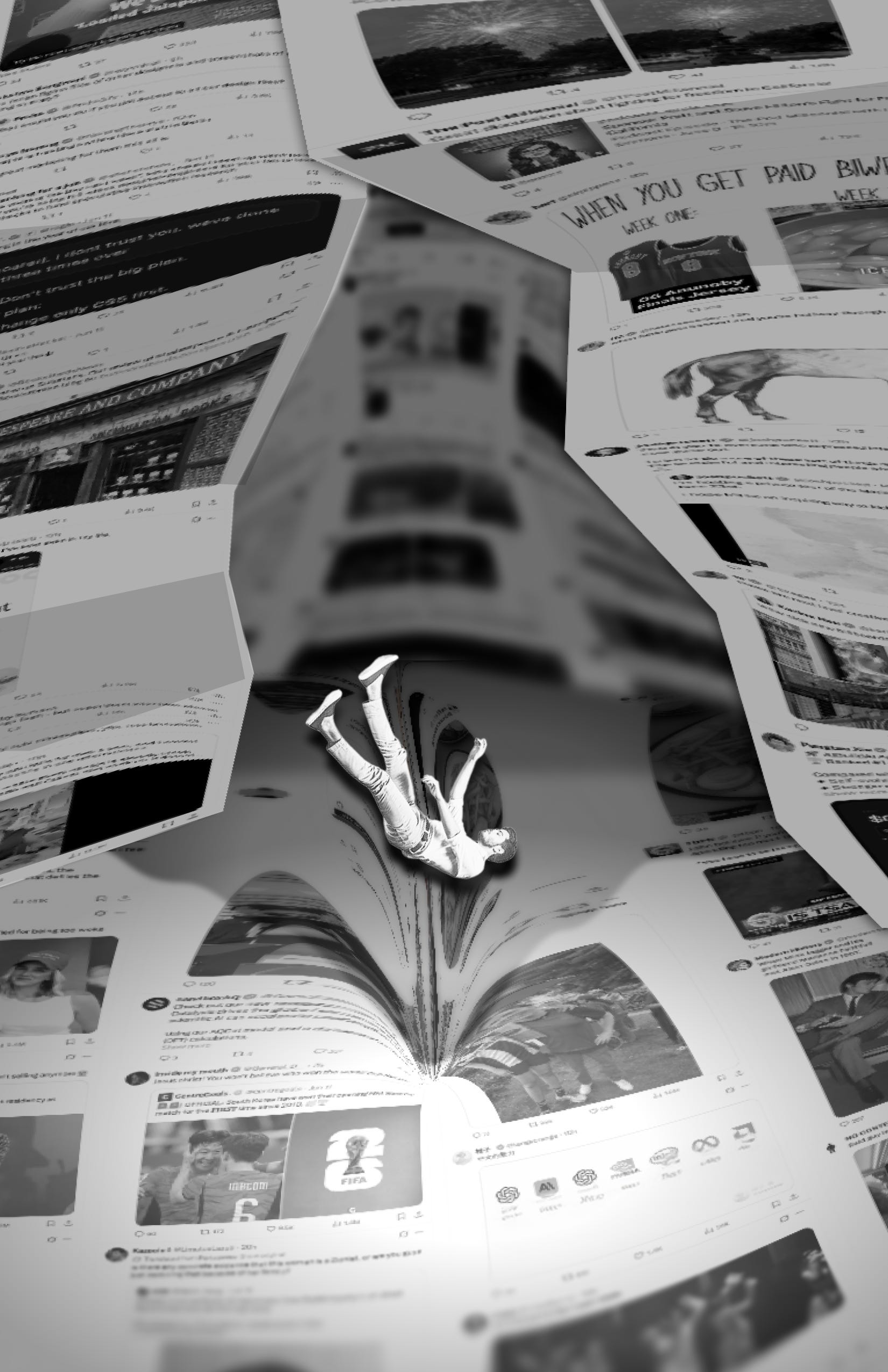
It’s fun, sometimes, and unlike the temporally bounded medieval tradition of carnival, it never has to end: if carnival was “a completely different, nonofficial, extraecclesiastical, and extra political aspect of the world, of man, and of human relations . . . a second world and a second life outside officialdom,” now, thanks to innovations in the technology space, we can live forever secondary lives, even in bed: we’ve got da phone! We can read tweets wherever! Life is so beautiful, we think, until, taking some time to relax and recharge, we crack open another one of Bakhtin’s books, The Dialogic Imagination, and encounter the concept of the chronotope, that literarily conscious coupling of time and space, the way “[t]ime, as it were, thickens, takes on flesh, becomes artistically visible; likewise, space becomes charged and responsive to the movements of time, plot and history.” Bakhtin uses the example of the chronotope of the road, which, in many Englishes, we’re familiar with on the level of idiom: life’s a highway, or a journey, perhaps, and look how far we’ve already come, where we might be going, that crossroads we’ll be spinning our wheels at before turning it all around, doubling back, being, once more, lost, directionless, and so forth, and so on, for the rest of your life, but Twitter’s got a more constrained temporospatiality: there, you mainly move vertically, and typically you’re going down: “a world that has its life and movement tensely strung along a vertical axis,” Bakhtin says of Dante’s hell, that eminently Twitter-y literary construction, a “vertical world [whose temporal logic] consists in the sheer simultaneity of all that occurs,” where “everything that on earth is divided by time . . . coalesces into eternity, into pure simultaneous coexistence.”
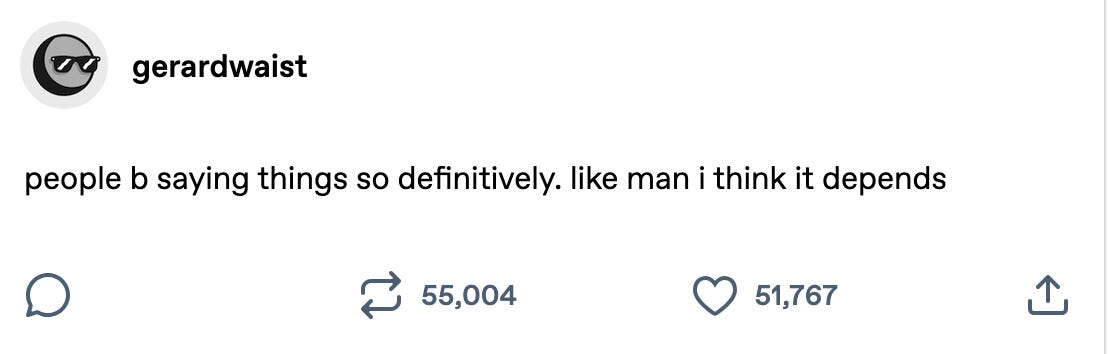
That is the experience of a typical Twitter scroll: your funny underemployed friends are being funny and underemployed; a hospitalized Palestinian child was just murdered by an Israeli bomb, something another Palestinian had to record and upload, for you; your crush is down bad for someone else; your tweet, which you posted because you were down bad for your crush, is still flopping; meme; meme; more gore; worse meme; politics; meme; discourse; meme; porn discourse; meme discourse; worse porn discourse; porn; and well, basically, the economy is collapsing and the climate is collapsing and well over a decade in, people don’t appear to be any closer to figuring out whether or not it’s woke to read1 — emotional whiplash abounds, but thankfully, you’re used to it, and if you do want it to stop, at least you have the option of walking away from the screen. For Bakhtin, one of the defining features of carnival was that it was “by no means a purely artistic form nor a spectacle,” something that “does not, generally speaking, belong to the sphere of art” but to “the borderline between art and life. In reality, it is life itself, but shaped according to a certain pattern of play,” something that no doubt has many liberatory potentialities, although with the drawback that talking all that shit in real life may have more tangible consequences, like getting hit, e.g.
As an artistic form and/or spectacle, then, Twitter is closer to what came between the medieval European tradition of carnival and The Phone’s global proliferation, that being the modern European tradition of The Novel. Once the easiest form of artistic entertainment to have in your living room, and also the easiest form of artistic entertainment to take out of it, The Novel was also the best way to be unaccountably nosy about whatever was going on in other living rooms, and a profound vehicle for the sorts of narrative self-fashioning enabled by capitalist modernity besides; these days, however, a few hundred years into the bourgeois cultural revolution, those things have become more or less the fabric of our society, and reaping what it’s sowed, what can The Novel say besides, well this fucking sucks, what the fuck? Yes, The Novel has seen better days, we hear, and sometimes echo, on Twitter: where has all the Great Literature gone? Remember those Great Writers who would swallow the entire world, digest it, and shit it back out into something new . . . beautiful . . . profound . . . canonical . . . someone like Fyodor Dostoevsky, a Russian novelist Bakhtin credits with introducing “polyphony” into the novel space, meaning that in his multi-voiced novels, Dostoevsky’s was never louder than any of his characters’. It was in this dialogic “plurality of equally authoritative ideological positions” that the period of dramatic capitalist transformation in which Dostoevsky was writing — that gradual melting down of all society’s divides into our present egalitarianism, in which we’re all free to do whatever we can afford — found its “fullest expression.”
One problem here, of course, is that just as with any other party, novels do have to end:
We do in fact observe in Dostoevsky’s novels a unique conflict between the internal open-endedness of the characters and dialogue, and the external (in most cases compositional and thematic) completedness of every individual novel. We cannot go deeply into this difficult problem here. We will say only that almost all of Dostoevsky’s novels have a conventionally literary, conventionally monologic ending.
Also like parties, novels tend to have space constraints: try as it might to capture the totality of human society, The Novel is a bounded form. As Alex Woloch says in The One vs. the Many, while the “realist novel is infused with the sense that any character is a potential hero,” concretely, novels have their protagonist(s) and their minor characters, those whose lives have been dignified by the narrative focus and those whose lives it’s shunted. This distortion of perspective is not unique to The Novel and pertains more to the structure of narrative itself — as anyone who has tried to think about history or society in a single narrative has surely seen — but that’s why we came up with the idea of ensembles: with only one narrative, we can only have a few protagonists, but with a shitload of them, working in tandem? Wow! Now we can call it polynarrative! Woke!
It’s too bad, then, that Bakhtin didn’t make it to the age of Massively Multiplayer Online Role-Playing Games, or any of the novel internet-literary forms they rhyme with, because interpreted artistically, Twitter is — essentially — a novel ludonarrative in which any user can be the “main character,” resolving the problem of narrative focus caused by spatial boundedness, and also, unlike any MMORPGs I know of, one whose “open world” is user generated, as Twitter players tend to be reactive to the things that are happening both inside and out of that world, endlessly creating new terrain for the other players to explore; whatever kind of art-object Twitter is, it’s capable of sustaining itself indefinitely, at least until its players decide to walk away from the screen. But why would they? What if you post good and get a book deal . . . or even some other desirable thing . . . or experience . . . or perhaps some even other third thing, experience, or other entirely different category of phenomena instead, not always desirable (a lot of ways to get fucked), but, for the players who prefer lower risk fun, there’s always posting anonymously, and where would Twitter be, in the final analysis, without its legions of casual players, those posting for nothing more than the love of the game and the hatred of the professionalized tryhards it entails . . .
What, it’s wondered, are they even trying for? One important thing distinguishing Twitter from many other open world video games is the absence of a centrally organizing “main quest,” perhaps the only one being to one day be successful enough to no longer have to be playing Twitter, thus, with one turn of the historical materialist screw, it turns out that Twitter lowkey has something to say about the conditions of its own production, which is to say, the place it was created, Society, at least, the capitalist one, which, at this stage, also has no real organizing main quest (or “master narrative”) aside from its various individual players trying to make enough money to no longer have to play its stupid games. In both worlds, gameplay is determined largely by structural mechanics that are so broadly accepted so as to be invisible; this is one reason the various Twitter expansions — Bluesky, Substack Notes, X, etc. — offer more or less the same experience, a sort of miniaturized lab experiment for a species of liberalism that sees progress in society as emerging from leaving everything basically the same, minus the player base, who may use all sorts of different outfits, weapons, spells, skill trees, and so forth to try to make their experience playing the same game meaningfully different. Surely, this can work, but, as in any videogame, the meta involves trying to exploit or even change the mechanics of the game, something that does work, albeit with some drawn attention: when fascists and communists try to change society, we see “a revolution” carried out by human agents, whereas, in the words we apparently have to use now, when “late-stage capitalism” is causing rampant “enshittification,” well, that’s something that sort of just happens . . . inevitably . . . not because of . . . the conscious decisions of many autonomous individuals, considered in aggregate as a class (dialectically), but because of . . . Society . . . that secular Godthing that we . . . can’t change . . . except . . . by accident . . .
Given all that, some may reason it’s better not to think too hard about how things we take for granted as permanent fixtures of our reality are actually the product of conscious human labor, especially if you’re hungry, because what if you go get a snack and end up like a character in a novel by Benjamin Kunkel, Ben Lerner, Heike Geissler, Ling Ma, Lucy Ellmann, Sally Rooney, Ruth Ozeki, and Daisy Hildyard, that is, experiencing the "supply-chain sublime,” as Mitch Therieau, Spencer Robins, and Hugh Foley have called it, updating what was once known as “the sweatshop sublime,” something Bruce Robbins drew out of a novel by David Lodge, all of which are basically referring to that at first exhilarating awareness that — as you surely, on some level, already knew — your food was harvested by workers using tools built by workers using tools designed by workers using computers designed, programmed, built, marketed, and also delivered by workers, whose ability to deliver, market, build, program, and also design things has been facilitated not just by the various physical commodities they interact with on a daily basis, and the workers behind them, but a long history of intellectual labor besides, and the workers behind it, not to mention the workers behind those workers, and every other, cooking, cleaning, healing . . . a soaring vision that can be genuinely exhilarating (the power of collectivity! the incredible achievements of the human race! the indomitable human spirit!) until it nosedives, mid-flight, when thinking about just how many of these jobs suck and the economy is collapsing and the climate is collapsing and this is such a stupid way for human history — the totality of which is contained here, in this bag of quicos — to end. Yahoo . . .
For those looking to duck such an experience, it’s recommended not to look up from your treat, either, as the totality of human history is lurking in every other commodity, of which there’s really kind of a shitload, says Karl Marx, at the opening of his Capital — “[t]he wealth of societies in which the capitalist mode of production prevails appears as an ‘immense collection of commodities’” — and these commodities even come with their own namesake fetishism that obscures the social relations and real humans doing real things to produce them, something some people apparently think it’s a good idea to try and unobscure all the time, which is sort of like trying to calculate the gravitational force acting on every object you pass on a walk, as, as Marx says later in Capital, the various laws of capitalism work a bit like “the law of gravity,” being the sort of thing that mostly “asserts itself when a person’s house collapses on top of him.” Seeing into the matrix, as it were, is really most useful when you’re part of the real movement to change the matrix, but otherwise, it usually just makes it harder to play the game, unlock achievements, do cool combos, and hit all the high scores and shit, something known to require a good bit of gamer fuel, and no option will be more zeitgeistful here than Soylent, a bland meal replacement sludge whose main appeal appears to be that it lets you drink numbers: its website advertises a single bottle’s “20g protein,” “28 vitamins & minerals,” and “12 brain boosters,” and with our brain dodecaboosted, our bodies vitamineralmaxxed, and our 20g of protein, we may as well say a premature goodbye to the long human history of eating and cooking, whose embodied and social pleasures can surely offer us little compared to this abstract, hyper-rationalized, and textureless “slop,” which offers us no less than a high score. And that’s the main thing we want out of life, no? Why eat, when you could be a person who ate?
Well, eating does help with having a fat ass, when you’re hungry like that, and even yearning for other, different but still tangible realities and experiences besides, the kinds of things we could do and enjoy and even write about at a later date, offering up to others food-for-thought style, knowing full well, of course, that they know, full well, of course, that they’re only eating thoughts, but that also, thoughts have the nice quality that eating them actually makes you think, itself an embodied experience, if you’re doing it right, all of which leaves your body, which includes your brain, a little more open, a little more grotesque, and with those thoughts sitting inside you, and you sitting inside those thoughts, and every single thing in whole wide universe going in and out of itself, endlessly, one day, the time will come when you’re ready to embrace those eternal words of the literary world’s most unorthodox book distributor, Mao Zedong: “if you have to shit, shit!”
🌀 microdoses
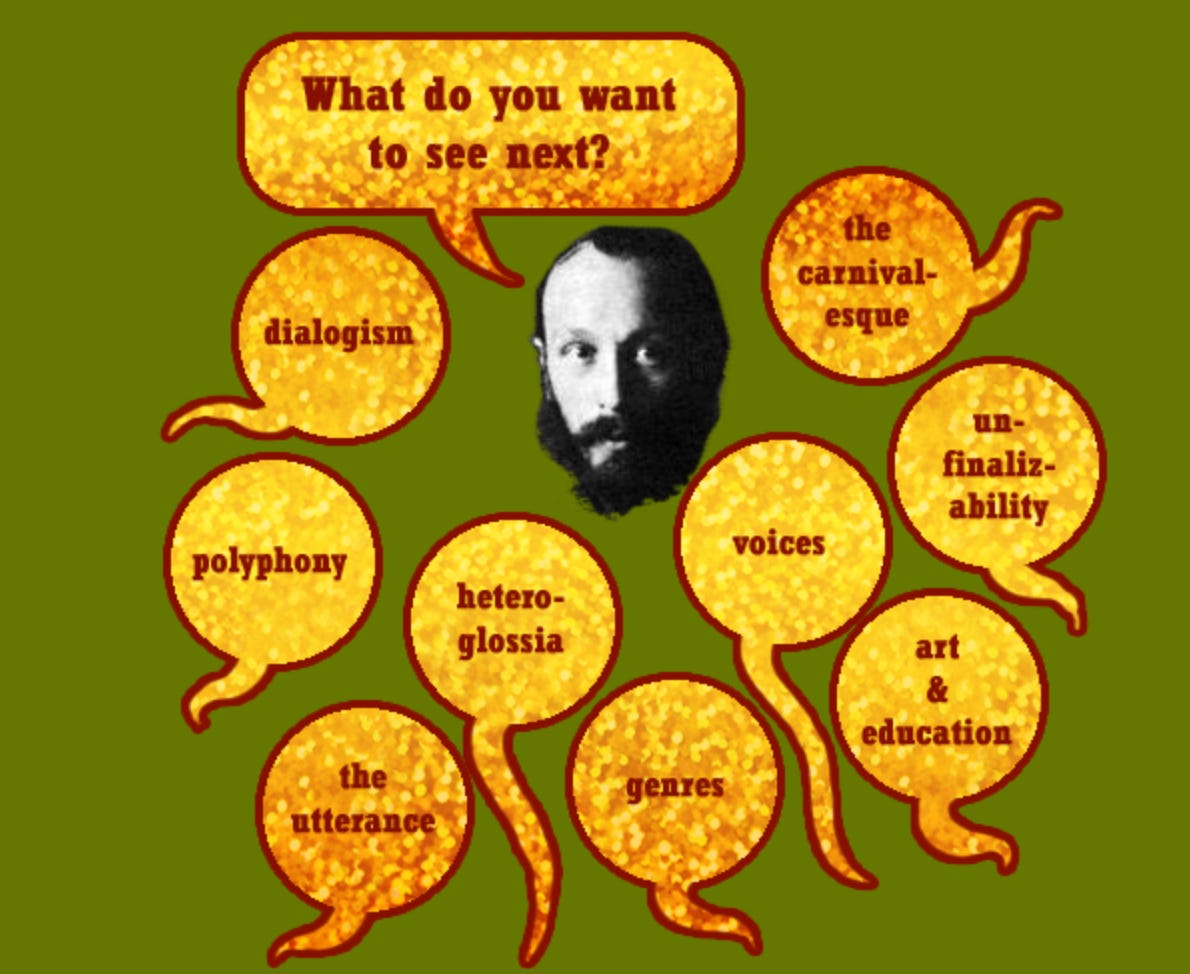
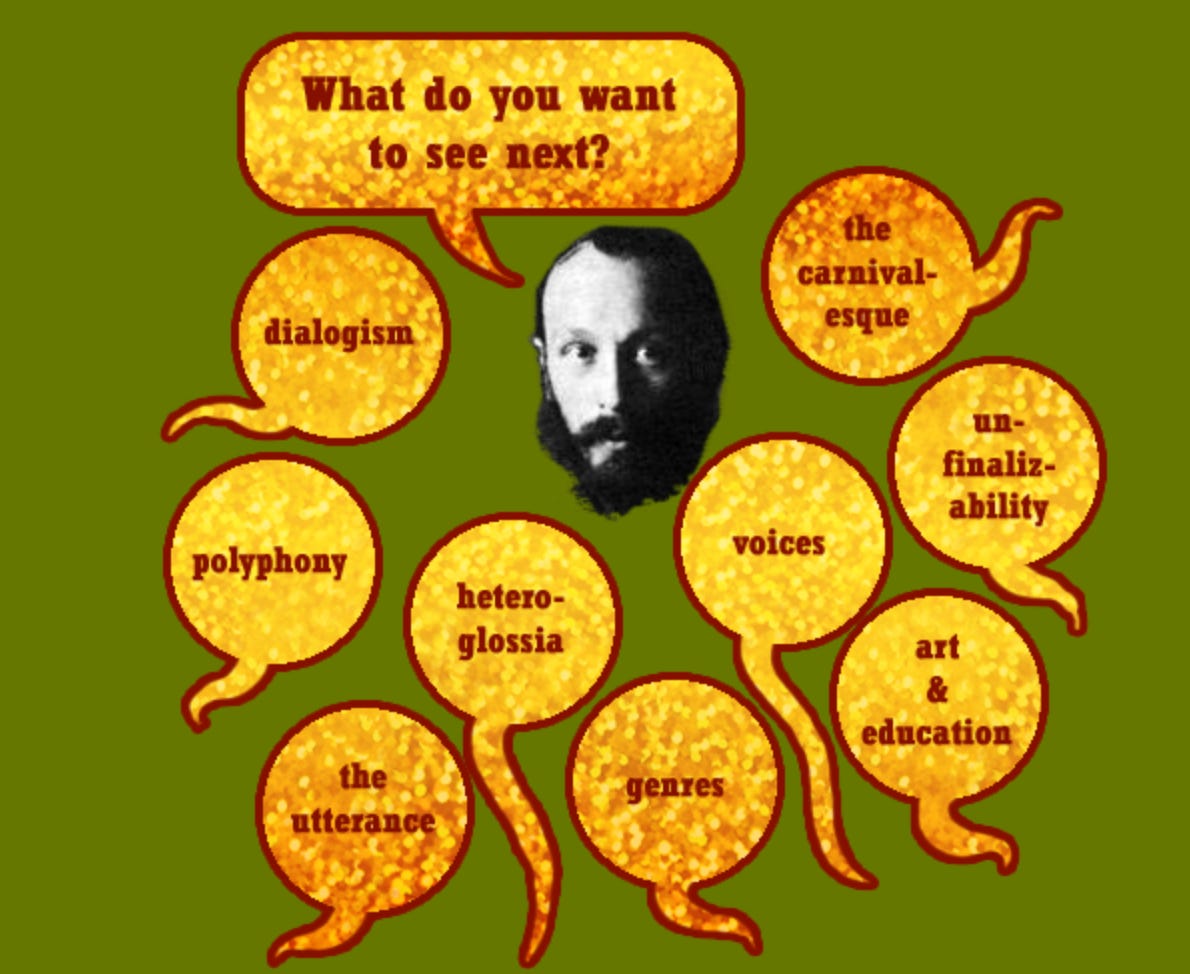
Very charmed by this website from an art education professor on the work of Bakhtin! What do you want to see next?
If you liked this essay, Isabel’s two novels, School and It’s the Characters!, are available in print and on all reputable piracy sites (she uploaded them, dw)!
Happy “There Will Come Soft Rains” week!
Dreaming of the Frank Herbert Orientalist Dinner Party: