


Kernel Issue 6: FEED is ready to be devoured. In anticipation of our Toronto event this week, we’re sharing another delicious essay from the issue. This piece is about the citational disasters and joys of food writing on Wikipedia, and the difficulty of creating archives for dishes which form central but ephemeral pieces of culture. Dig in!
And please join us for our Toronto launch party at 1RG on October 8th—we’ll have snacks, readings, and a Wiki-food activity for you to chew on!
—Shira Abramovich

🌽 How to Cite a Fried Egg 🔩
By Sophie Wu
Edited by Shira Abramovich
Contrary to popular belief, cornflakes weren’t invented to prevent masturbation. I learned this from Wikipedia the last time I poured myself a bowl — they actually came to John Kellogg in a dream. After an intense cookie baking marathon, I discovered that vanilla cultivation stumped Europeans for centuries until a 12-year-old enslaved child genius, Edmond Albius of Réunion, invented a method of hand-pollinating the plant. In line at a café, I learned the popular myth that croissants sport their iconic shape as a result of Viennese bakeries celebrating the lifting of the siege over the city by producing an edible symbol of their enemy — the Ottoman Empire’s crescent moon flag.
Whenever I sit down to eat, I pull up Wikipedia. A great food page — some of my favorites include “Maple Syrup,” “Pad Thai,” and “Sandwich” — will tell you more than what’s on your plate; it surfaces all the broader forces that have made it possible. But although I have benefited immensely from Wikipedia’s food pages, I am also often disappointed by their shortcomings. Many of my favorite childhood snacks, easily discovered in the aisles of any Chinese supermarket, simply don’t exist on English Wikipedia. Many pages — even for widely eaten foods — can be remarkably short. Many lack citations. Signs of the community asking for support are littered across articles both long and short: “Citation needed” superscripts for uncited claims, or banners requesting user assistance to correct poor Wikipedia editing practices, like disputed neutrality or incomplete coverage.
Food has long been underserviced in the archive. Traditional food-related knowledge is passed down in ways that are often difficult to find, preserve, or verify — like oral tradition or family recipe books. Adding to that difficulty, the industrialization of contemporary food processes has severed the relationship between producer and consumer that once sustained this knowledge. Even well-documented records of culinary history have often been treated as marginal within history writ large — the field’s association with the domestic sphere has long disqualified it from being viewed as a “serious” historical field like military or economic history. As a result, today’s gap in Wikipedia’s food coverage is a symptom of a much larger problem: the systematic undervaluation of food-related knowledge.
Too few cooks in the kitchen
Quality information sources for even the most popular foods can be difficult. In her 1986 cultural history of food Much Depends on Dinner, writer Margaret Visser laments the difficulty she encountered researching the history of the humble onion: “I am not one of those who despise the study of ancient battles, but I am a child of the twentieth century and surely I had a right to know at least as much about the history of a troublesome but eternally useful vegetable which I personally chopped and fried several times a week?” As Visser emphasizes, the commonplace nature of a food can make it harder, not easier, to trace — its ubiquity a reason it was never thought worth the hassle of documentation.
Consider the “Fried egg” article on English Wikipedia, which cites next to nothing while claiming how fried eggs are eaten all over the world — from Indonesian “bull’s eye eggs” (sunny side up) to German “strammer max” (also sunny side up, atop a ham sandwich). A fact is considered “verifiable” on Wikipedia if a reliable source that supports it could be cited, and Wikipedia’s core sourcing policy states that all content should be verifiable. But what reliable source certifies the popularity of “fried eggs on ham” in Germany? Googling ‘Strammer Max’ offers little reassurance: the Wikipedia article ranks first, followed by recipes and Reddit threads for the next five pages — none of which fall under Wikipedia’s ideal citation policy of reliable secondary sources.
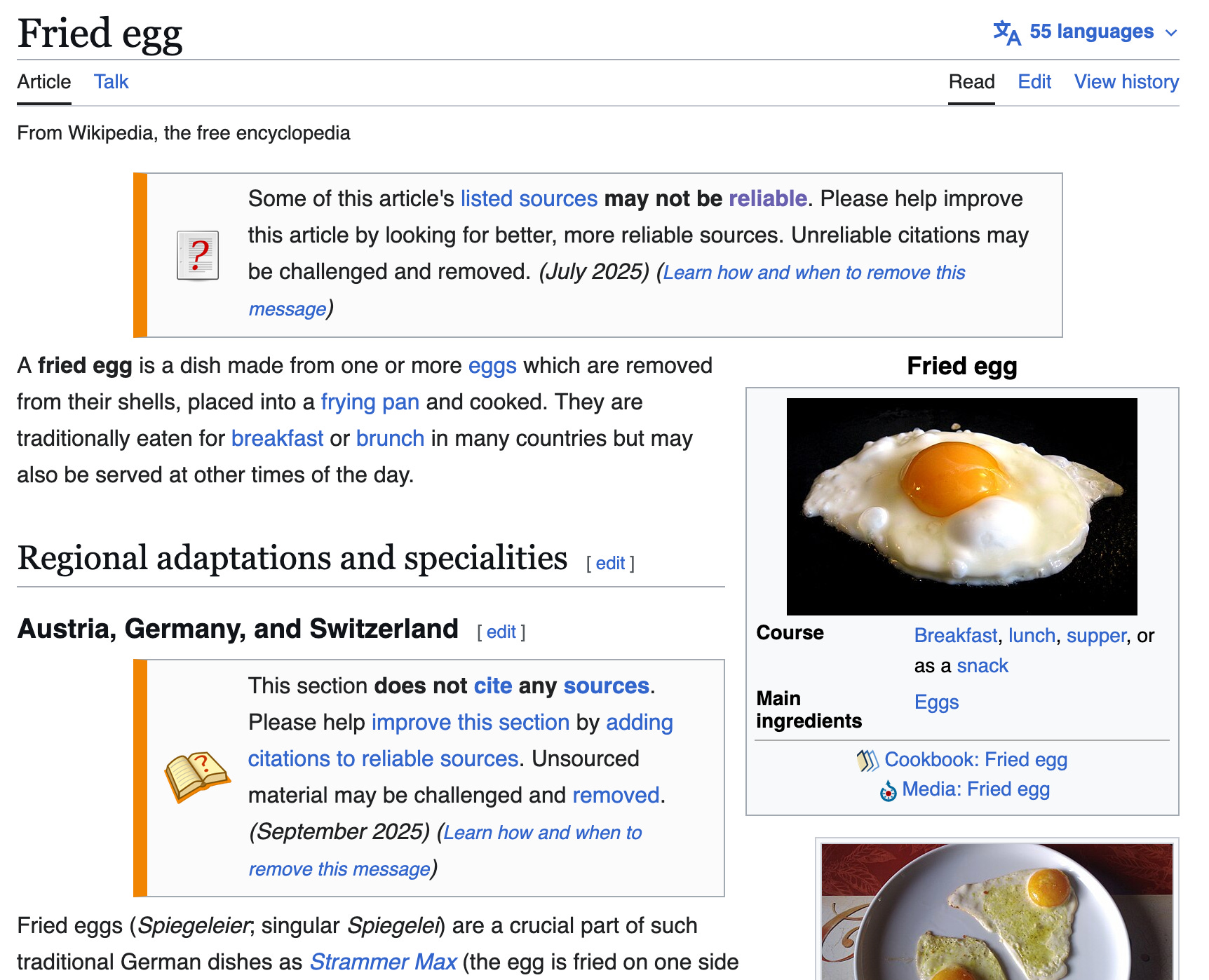
This issue places a “chicken or (fried) egg” dilemma to the Wikipedia community tasked with improving food coverage. In the common cases where credible sources are difficult to find, the challenge of making comprehensive food pages is made more demanding. Unsurprisingly, this means that many food-related pages are stubs, a type of Wikipedia page that is extremely short and minimally informative. There are around 1000 listed under the “Food and drink stubs” category on Wikipedia, with many more likely uncategorized. While stubbiness is a problem across Wikipedia’s coverage, food-related stubs stand out for representing topics that are often deeply familiar for the average user. Unless you are a serious birder, I doubt you have heard of the “Colombian grebe” or “Journal of Raptor Research” — both listed under the “Bird Stubs” category. Meanwhile, you have probably heard of (or even consumed) “Corn Snack”, “Flavored Syrup”, or “Canned Beans”, all stubs under Wikipedia’s Food and Drink project.
Stubs reveal unfilled niches in the food information ecosystem. Poking around their weaknesses can indicate areas where robust research is difficult, or where Wikipedia needs more editors on deck. Take “Canned Beans” as an example. It claims that “the canned variety may have a more soft and mushy texture than their dried and soaked counterparts”, citing a PDF from the Canadian federal government providing public servants an official guide on making legume-related supply decisions. While the official state guidance is appreciated, the page does not say much else. Considering the global canned bean industry is expected to double in the next half-decade, I have to believe there is more to canned beans than their mushiness. I, for one, have definitely been seeing a lot of canned beans on the ‘TWENTY MINUTE SUNDAY MEALPREP RECIPES TO TRY!!’ recommended to me on Instagram reels. A history of the canned bean would surely be revealing of the various social, historical, and environmental factors that make this ingredient so ubiquitous today. But without enough secondary sources and the Wikipedia editors to tie that information together, this story will remain as obscure as the bean is commonplace.
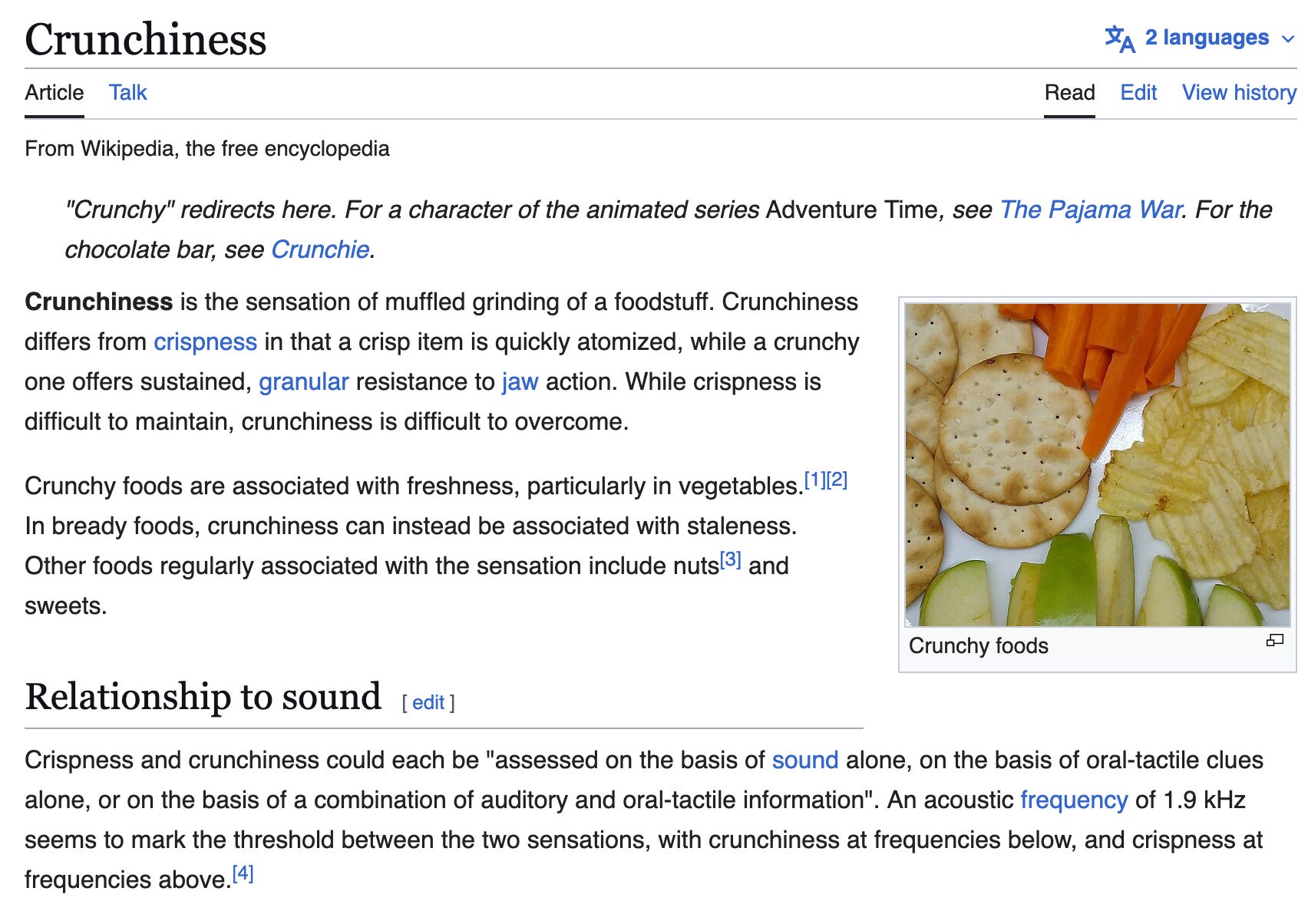
Unsurprisingly, “stubbiness” is undesirable, and Wikipedia labels pages as stubs largely to encourage editors to expand these topics to a fuller length. Yet even a sparse stub can make an underresearched topic more researchable by establishing its basic silhouette, and at minimum making the subject feel legitimate and locatable within a broader body of knowledge. One of my favorite stubs is the “Crunchiness” page on English Wikipedia. The content focuses primarily on the distinction from “crispiness” — which, yes, also has its own Wikipedia page. It informs readers that “an acoustic frequency of 1.9 kHz seems to mark the threshold” between the two mouthfeels — cited robustly, using a secondary source paraphrasing a verifiable scientific result. It also features the incredibly quotable statement: “while crispness is difficult to maintain, crunchiness is difficult to overcome“ — uncited, but with an air of profound and poetic truth.
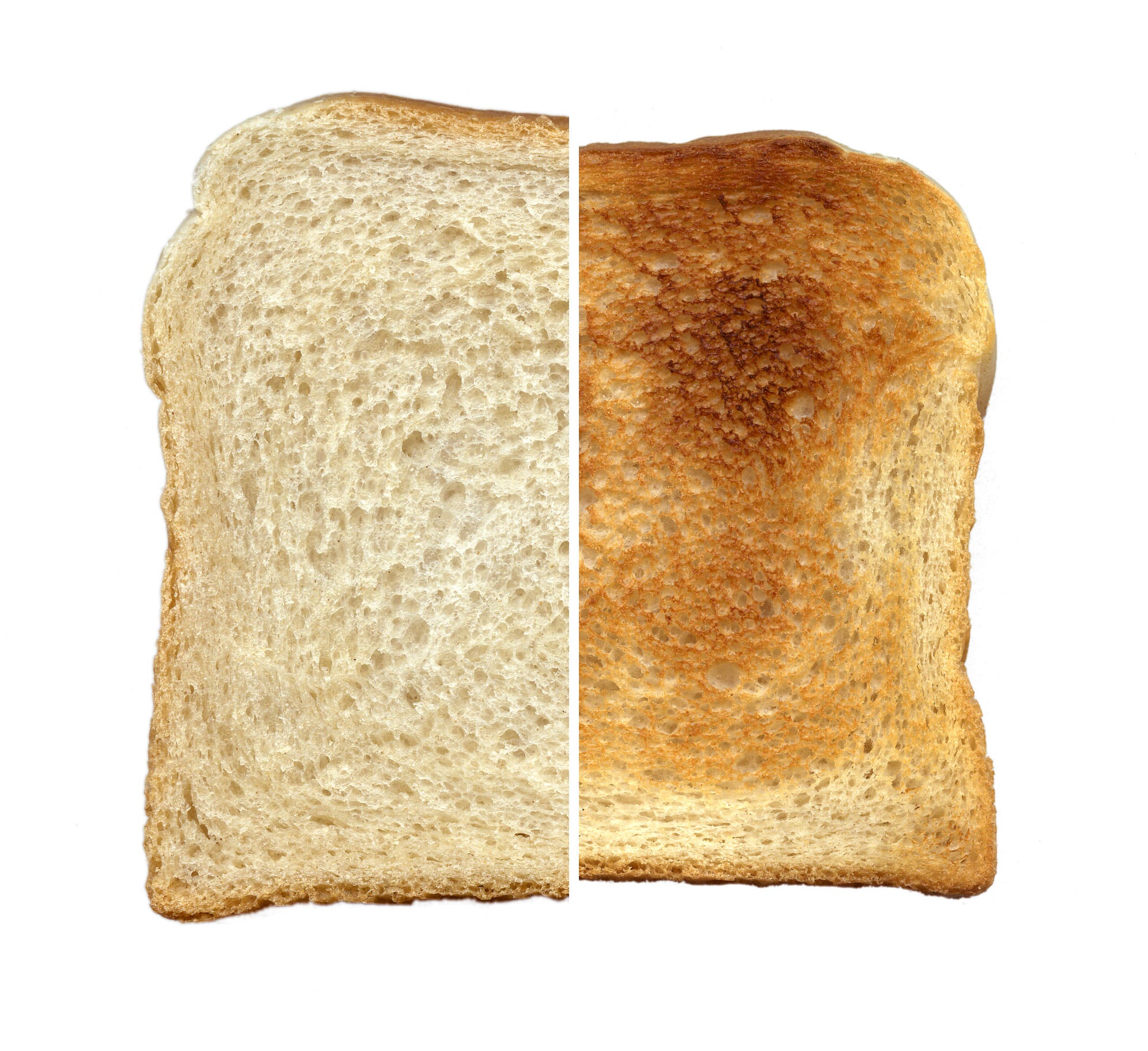
Wikipedia pages often describe familiar details about their subjects in an editorialized language that is made comedic when containing an everyday subject, presenting like an alien scholar trying to explain human life on planet earth. Somewhere out there, someone volunteered their time to carefully curate, edit, and upload a picture of “a slice of bread, before and after toasting”, perfectly split along a central line to illustrate the toasting process, on the “Toast (food)” page. Some other user added the statement that “The firm surface is easier to spread toppings on and the warmth can help spreads such as butter reach their melting point.” Together, these efforts ensure that toast’s fundamental significance receives the same serious care as any other topic humanity has deemed worthy of documentation.
The abundance of detail on these pages is the result of remarkable generosity from strangers — made all the more apparent considering food-related topics that lack representation on Wikipedia. Some entries, especially for regional foods, exist only in specific language versions: a friend tells me proudly that his childhood favorite, Молочный суп — milk soup, essentially pasta boiled in slightly salted milk — is so Russian-coded that no English Wikipedia article exists for it. “Rice bowl,” “Skin (food),” and “Gluten-Free Wheat” all currently reside in the “Requested Articles” section, a strange Wikipedia purgatory between recognition and documentation.
Neither I nor my friend would likely ever create the “Milk Soup” page on English Wikipedia, although either of us technically could. I use Wikipedia daily, yet I cannot name a single person I know who regularly creates new Wikipedia articles. Today, the plethora of accessible information available on the internet feels inevitable as tap water. But like our potable water infrastructure, our informational infrastructure exists because of labor we often take for granted: the Wikipedia editors who keep up the foundations.
Fresh from Wikipedia’s oven
Timothy Meeker began editing Wikipedia two years ago with an explicit desire to contribute to something larger than himself: “I really just had this itch to create something that would kind of give back to a larger group of people.” In an era when generative AI is flooding the internet with unverifiable text, Meeker finds Wikipedia’s community-enforced standards increasingly valuable. “I kept coming back to Wikipedia over and over again as being like, oh, I can feel pretty confident that this is actually a real person. Because the community’s looking out for that.”
So, how does Meeker create a new food article on Wikipedia? The first step is finding a gap — and naming it. Even this can be a challenge for foods uncommon in the Anglophone world. Meeker once had to invent the English name for “Rolled Flour Porridge”, a family of porridges in West Africa and South Sudan. Wikipedia already featured pages for these porridges in Wolof and French, two common West African languages, but no sources documented an English name. Even naming requires careful consideration of the cultural context of the food: “I had to make one that is non-editorializing, something that’s just very straightforward. I actually messed this up first. I called it couscous porridge. And then I was like, wait a second, that’s implying North African influence, I need to roll that back.”
Then there is the iterative process of using all possible names to search for reliable information sources, and adding relevant information to the article — and then rinsing and repeating, however many times it takes. Wikipedia editors often go beyond basic web searches to find useful sources, using sources such as the Wikipedia library, a set of subscription-only research databases available freely to any Wikipedian who has made more than 500 edits. Meeker relies on the Wikipedia library extensively, alongside machine translations of non-English sources. Throughout this process, Meeker tries to avoid sources without their own editorial process, such as blog posts, admitting this can greatly limit the kinds of pages available to cite food-related claims. For example, when looking for sources for Rolled Flour Porridge, many of the formal English reports were too generic to be useful. “A lot of NGO work, or the UNHCR, and that sort of thing, they’ll just glaze over it and call it porridge. So it’s not really helpful. Or, they won’t use any native terms. They’ll just call it a millet porridge, and that can refer to, like, seven different styles of porridge.” Ironically, the ordinariness of a food — its ubiquity for certain populations — often contributes to its lack of robust coverage. “It’s just porridge. No one wants to write about porridge. It’s insane.”
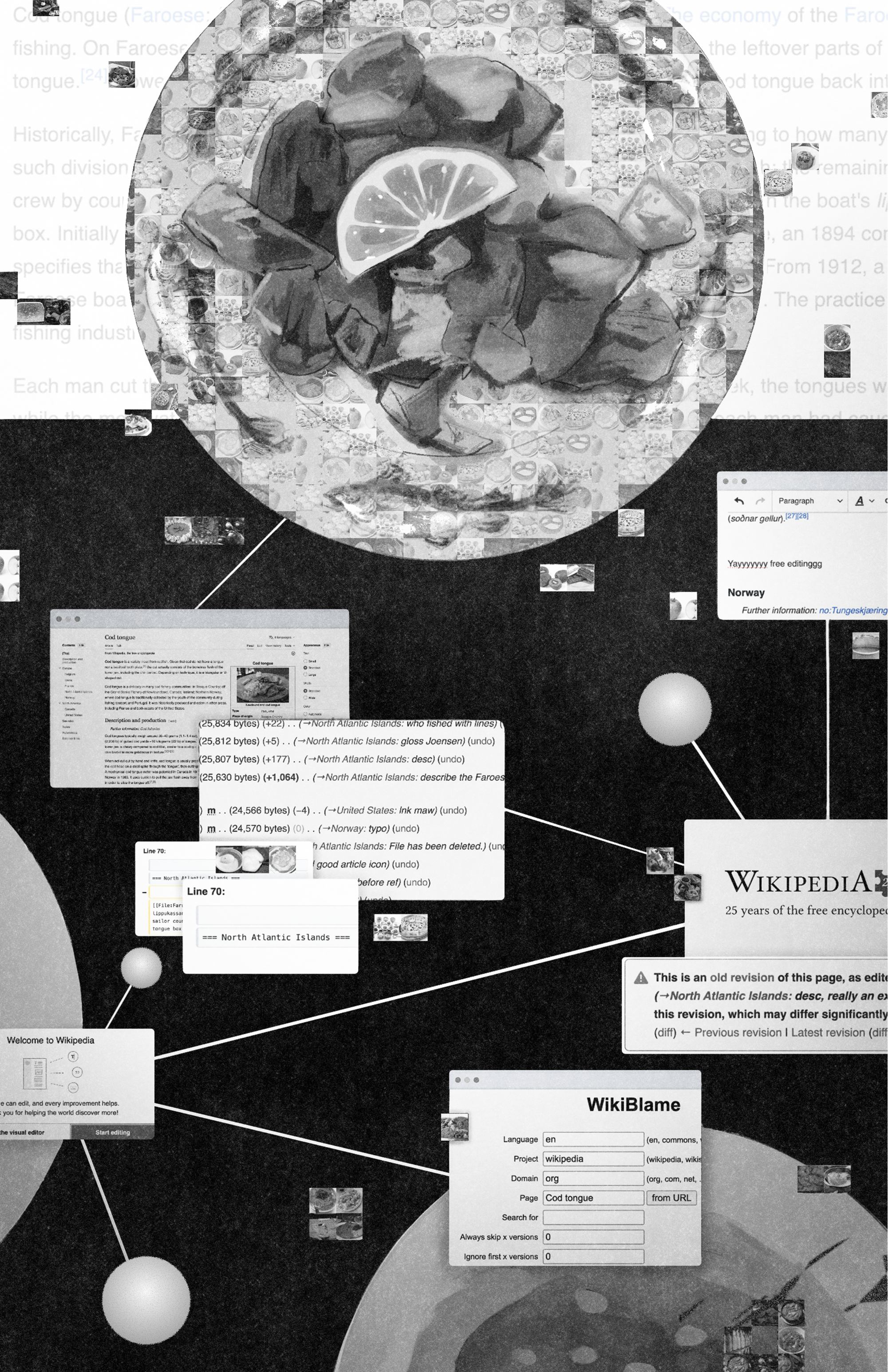
Sources often only briefly mention the food subject at hand without formally expanding on its details. Meeker considers it irresponsible to rely exclusively on such sources, but acknowledges that they can still be useful when filtered for substantial information. When writing out the history for “Cod Tongue,” a delicacy eaten in various fishing communities worldwide, Meeker searched through various 18th and 19th-century books on the fishing industry for relevant content on fishing community practices, carefully angling for “a very small part of what otherwise is a 500-page treatise about catching as many fish as possible.” Meeker described the process for building out this page — which now documents a half-dozen different local variants — as an ongoing and elusive chase, in part due to how widely this dish is eaten: “This was my white whale for a couple months, because every single time, I think I finished it. And then I’d find out about a new country, and… Here we go again.”
Consideration for political bias can also shape editorial choices. This came up recently for Meeker when producing the page for “Boulaghmane,” a dish originating from Mauritius and Western Sahara, as part of a recent Ramadan edit-a-thon encouraging users to improve coverage for Iftar-related foods. The challenge was whether it was responsible to include Moroccan sources for the dish — a sensitive question, given that Morocco’s presence in Western Sahara is contested by Indigenous Sahrawi populations. Meeker eventually decided these sources were appropriate, given the robustness of the information and the limited coverage from other sources, although not ideal — “at least in the coverage that I found, it was pretty straight up and down, just descriptions of the food.”
This same sensitivity extends beyond geopolitics to the subtler ways that cultural bias shapes which foods are treated as worthy of serious coverage. Meeker also works actively to improve Wikipedia’s representation of ”taboo foods” which may seem strange to the average Westerner, but are ordinary for those who consume these foods regularly. These include meat offcuts (such as cod tongue), organ meats, and insects. Meeker notes that these pages, in spite of their supposedly neutral presentation, can give a degrading perspective through exclusively citing brief descriptions and shock articles. The “Kunga Cake” of the African Great Lakes region, made of compressed midge flies, is offered as one example: “The page is essentially like, ‘oh, isn’t it yucky that this is eaten this way?’ And the citations barely expound upon just saying that it exists.” Meeker aims to create lengthier pages with a broader range of reputable sources for these foods in part because he believes this can make them less taboo. “Being able to describe it at length, as opposed to just having a little stub just saying it happens, does a lot for giving a practice the due time that a topic requires. You’re not just making a value judgment and passing it off, you’re actually learning about it.”
Growing up, I remember being warned to never use Wikipedia because anyone could put the wrong things down. But hearing how Meeker described his editing process, I was struck by how Wikipedia’s beauty — and usefulness — arises because anyone can put the right things down. It’s because of this belief in collective truth-seeking that parts of Wikipedia now rival professionally-edited encyclopedias, like Britannica, for information quality. As misinformation permeates many online platforms, this dedication to truth seems both admirable and almost miraculous in its effects. But calling this a miracle is also a disservice to what really makes the project tick: a system designed to empower any well-intentioned user to improve its offerings.
Chat, is Wikipedia cooked?
As daunting as page creation may seem for an individual to complete, Wikipedia articles usually evolve gradually through the work of many hands. However, just because anyone can edit does not mean that everyone does; massive inequalities in Wikipedia editor demographics are well-reported. Nine in ten editors are male, and more than half of all editors reside in Europe or North America. This skew has direct consequences for food coverage: Roberta Wedge, 20-year Wikipedian and organizer of food-focused edit-a-thons with the Oxford Food Symposium, puts it plainly: “Military technology and military stuff is coded male, and food is coded female.” Unsurprisingly, there are more than twenty times more military-related than food-related “Featured” pages on Wikipedia. Editorial demographics also distort the kinds of foods that are represented on the project. Compare Hindi Wikipedia, with 169,000 articles for over 600 million speakers worldwide, to French Wikipedia’s 2.7 million articles for only 312 million speakers. I’m certain that the “Indian Cuisine” category on English Wikipedia, which currently features fewer pages than the “French Cuisine” category, would be better represented if there was better Indian representation in the Wikipedian community.
Wikipedia faces an alarming existential threat today: while the total number of internet users has more than doubled since 2016, Wikimedia page views have decreased by 9%. Meanwhile, new user registrations have dropped by over a third, although total edits from existing members have increased. Christopher Henner, former Wikimedia Foundation Board of Trustees Chair, recently published an essay ringing the alarm bells for Wikipedia’s future, claiming Wikipedia is “becoming a smaller club working harder to maintain something fewer people see.” Henner shifts the blame from chatbot reliance to Wikipedia’s inability to engage with the increasing proportion of internet users from the Global South. “The billions of people who came online since 2016 aren’t choosing other platforms simply because they are flashier,” he writes. “They are choosing platforms that speak to them, that reflect their experiences, and that don’t require navigating arcane markup syntax and hostile gatekeepers to participate.” In this light, the food knowledge gap and the editor demographic gap are results of the same problem: an encyclopedia built by a narrow slice of humanity will always reflect a narrow slice of what humanity finds worth knowing.
As chatbots displace search engines and AI-generated content proliferates, it’s becoming easier than ever before for internet users to detach from the systems behind their information. But information systems can and should make knowledge accessible while bringing people closer to its origins. This philosophy is what Wikipedia’s success has proven true, and it’s what we risk losing if Wikipedia cannot reverse its decline. Maintaining the project’s connection to people’s everyday lives, through both its content and its relevance, is more important today than ever.
Setting a wider table
Wedge’s work in organizing food-themed edit-a-thons sheds light on a community-based initiative aiming to promote diverse engagement with Wikipedia. These day-long events familiarize individuals with the process of editing in order to improve coverage of underrepresented topics, such as food. Wedge describes these events as friendly, but structured: “We all rock up at half past nine in the morning, there’s one room which is designated for us, everybody’s expected to bring their own laptops charged up if possible. (...) And then in the first hour or so, the trainer — such as myself or somebody else — will explain how to edit Wikipedia.”
Wedge is a firm believer that anyone can edit Wikipedia, not least because there is so much to do. “If you are capable of sending an email, you are capable of editing Wikipedia — there’s nothing more technical than that.” At the food edit-a-thons, people often gravitate towards bettering Wikipedia’s representation of the cuisine of their region: “You know, they’re a bit shocked that their national dish or their regional dish isn’t included, or is poorly described.” Food editing underscores that the expertise necessary to Wikipedia’s growth comes in many forms, and that the free encyclopedia’s coverage is only as complete as the diversity of perspectives contributing to it.
Beyond expertise, she points to other meaningful work to be done: “You can add captions to illustrations, you can add illustrations, you can take photographs, you can improve the prose. If you have other languages under your belt, you can look at the other language Wikipedias,” she says. Wedge herself gravitates towards making pages discoverable within the broader ecosystem by linking and categorizing existing articles. These events are named after marathons for a reason: “It’s a long distance, it’s not a sprint, it’s not going to happen quickly or overnight.” The Wikipedia logo — a near-complete jigsaw sphere, each piece representing a different language’s alphabet — will forever be unfinished, a representation of all these small contributions connecting with each other to build the project. Most participants don’t leave edit-a-thons as seasoned Wikipedians, but for Wedge, the real value lies less in creating lifelong editors than in demystifying a system people encounter every day.
Unfortunately, Wedge notes that professional writers who arrive at food edit-a-thons sometimes also express a sense of disappointment that their contributions can be so easily revised. This ephemerality mirrors the fleeting nature of food; food is essential exactly because it is so temporary, disappearing into the rote work of keeping people fed. “By its nature, it’s there, and then it’s gone the next [day],” Wedge says. “And if people stop making a certain food, for all sorts of reasons — cultural or climatic or anything — then that knowledge can disappear surprisingly quickly, and it might never have been documented.” Without records, this loss of knowledge is permanent, leaving us with a poorer understanding of the many rich flavors and textures of human life on this planet.
The Wikipedia food editing community continues to work tirelessly and quietly against this threat, undeterred by the fact that any contribution could be undone at any moment. Meeker put it simply and honestly when I asked him why he is drawn to editing food pages: food history, he states, is “just so awesome to learn about — how a dish was created with purpose, how people in their environment took ingredients and willfully transformed them into something that not only nourishes them, but they enjoy within their culture… I get an appreciation for the fact that I’m just one part of a huge puzzle.” Wedge, for her part, keeps editing two decades in, picking it up and putting it down across twenty years “like some people pick up knitting”, she says, “because they want to do something, and so they’re doing it, and eventually they’ll have a sweater.” Somewhere out there — slowly, gradually, I hope forever — a sweater is being knit.
Sophie Wu is a PhD student in computer science at Columbia University, researching how LLMs can be used to study human culture and how the humanities and social sciences can inform more inclusive AI development. She previously graduated from McGill University with a M.A. in digital humanities. She thinks a lot about how technology can better support our understanding of human culture.
Shira Abramovich is a Lead Editor of Kernel Magazine and a member of the Reboot Editorial Board. She is an interdisciplinary researcher, translator, and editor based in Montréal, and is very happy with her first name.
🌀 Microdoses
hi everyone it’s jacob! i <3 wikipedia!
If you really enjoyed the discourse here about categories I highly recommend catfishing.net, a rather difficult guessing game based around wikipedia categories!
For more wiki-blogging, I recommend D.F Lovett’s Edit History, a remarkably thoughtful and thorough exploration of questions like:

Thanks for reading — if you enjoyed this essay, we’d really appreciate it if you shared or forwarded to a friend!
