


Kernel Magazine Issue 6’s creative work was curated by the Reboot Editorial Board’s own Hannah Scott, who did an excellent job bringing in poetry, art, and fiction that captured the feed in ways that essays could not quite reach. This short story from Vincent Huang captures something strange and inexpressible about how living in an age of information inundation and access to constant AI advice shapes our psychology. It’s an expertly observed piece of fiction, and one of the more heartwarming creative pieces we’ve published in Kernel.
Also, if you’re in New York: we’re throwing a launch party for Kernel 6 at Hex House in Brooklyn on November 8! We’ll be featuring readings from the issue as well as a behind-the-scenes look at the making of the magazine from Kernel Magazine Creative Director Connie Liu! We hope to see you there! Get your tickets now!
—Jacob Sujin Kuppermann

🌽 ECHOCARDIOGRAM 🔩
By Vincent Huang
Edited by Hannah Scott
My left forearm was tingling, a strange sensation creeping upwards from my wrist to my elbow. Is this the same thing I felt this morning? I wondered, but I’d already forgotten the details.
Memories were so fickle. Or maybe there’s a bug under the blankets? I hoped it wasn’t anything worse. Everyone knew strokes were most likely to recur within 48 hours of the original event.
I jolted out of bed and turned on the lights. The clock read 2 a.m. Fifteen hours since the incident, I calculated. No ants on my skin, no insects on my blankets. Just me, alone, with a body I no longer trusted.
Relax, the neurologist had said, it was probably just a migraine. But who had migraines that shut down half their body?
I pulled out my phone and texted the Oracle: i’m a healthy 22yo. my left side went numb earlier today but CT scans showed no damage. what are likely causes?
The Oracle’s reply: Likely causes include TIA (a “mini-stroke” that leaves no damage), migraine with aura (often recurring with headaches), panic attacks.
what would cause a TIA? I asked. I didn’t have a history of headaches or panic.
Most TIA cases are linked to PFO (a small hole in the heart), the Oracle responded. Rarer causes include arrhythmia and artery tears from injuries.
* * *
The next evening I went to choir rehearsal. I liked how formulaic singing was, how you could start with sheet music full of unintuitive intervals but if you drilled your sevenths and ninths enough your throat eventually learned to locate everything on its own; and if you practiced even longer you stopped needing the score because you had a copy of it inside your head. It was rare to find a setting where practice so reliably translated to mastery. I often wished I could rehearse the other parts of my life as well.
After rehearsal someone from the bass section waved at me.
“Hey, I’m Josh,” he said. “Nice bracelet.”
I looked down and realized I’d forgotten to take off the hospital tag. Then I looked at his right forearm — prominent veins, a deep tan, and a nearly identical tag.
Josh tugged on my wristband. “I guess we’re matching!” he joked.
“Um, yeah,” I said, confused at how he was treating the subject so frivolously.
For some reason Josh reminded me of the ocean. Maybe it was the deep, rumbling bass voice; or the arms that looked like a surfer’s arms; or the fact that he seemed at peace with his wristband while I was still at war with mine. I wanted to understand where that vast sense of peace came from.
* * *
When I arrived home I was greeted with a hug from my housemate.
“I’M SO GLAD YOU’RE OKAYYYYY,” she shouted.
Alice and I shared a 2-bed apartment in Rincon Hill. She was probably 90% of the reason I lived in SF. I’d read on Substack a few years ago that you should surround yourself with people who are free in ways you are not, and she was the freest person I’d ever met — dropped out of high school to investigate online fandoms, couchsurfed for a year while traveling the world, now running her own research lab on internet sociology. When she told me she had an empty room I accepted the first software job that would take me and immediately moved in.
I knew the job would suck, but it seemed worth moving anyway. I’d spent my whole life watching from the ground as birds soared through the air and now here was my chance to observe one from inside its nest. I thought maybe if I studied Alice closely enough, I could craft my own wings like Daedalus had. I would do anything for a chance at flight.
“So, no stroke?” she asked.
“I guess not.”
I didn’t feel like explaining that CT scans never actually ruled out strokes, so I said good night and went to my room. I wasn’t ready to sleep though. can you explain PFO in more detail? I asked the Oracle.
Its response: PFOs are small holes in the heart, present in 25% of people. With a PFO, blood clots that the lungs usually filter out can directly travel from the right side of the heart to the left side, and then reach the brain and cause a stroke.
I followed up: how do i get tested for PFO?
The patient will undergo an ultrasound (echocardiogram) while microbubbles are injected via IV, the Oracle explained. If a PFO exists, bubbles entering the right heart will rapidly travel to the left side.
* * *
I learned over coffee that Josh had gone to the ER for a collapsed lung caused by singing too passionately.
“So why are you still in the choir?” I asked.
“I missed singing.” Josh beamed.
“You’re a bass though. Everyone knows bass lines are boring.”
“Wow,” said Josh. “I know it’s not flashy, but basses provide important pedal tones. It’s the kind of thing you don’t notice until it’s not there.”
“Aren’t you worried about your lung collapsing again? If I were you I would’ve quit.”
“Well, it’s pretty uncommon. Like, would you stop walking outside because people on Twitter said SF is unsafe?”
“That’s exactly what I did when I moved here.”
“You’re so silly,” Josh giggled. “Do you always get stressed so easily?”
“I think I often start spiraling and questioning whether I’ll be okay, and then I can’t stop.”
“I’ve been there.”
“Really?” I asked. Josh seemed like the calmest person I knew.
“Yeah, I used to get these giant waves of anxiety, and I kept trying to fight them by winning arguments against myself or something.”
“So are you still anxious?”
“Sometimes,” said Josh. “But I learned that it’s easier to float on your back than to swim against the tide. You acknowledge the anxiety and then it’s not so bad.”
I told Josh I would try to float the next time I encountered a wave. I had no idea how though.
* * *
That night I emailed every cardiologist in the area to book echocardiogram appointments.
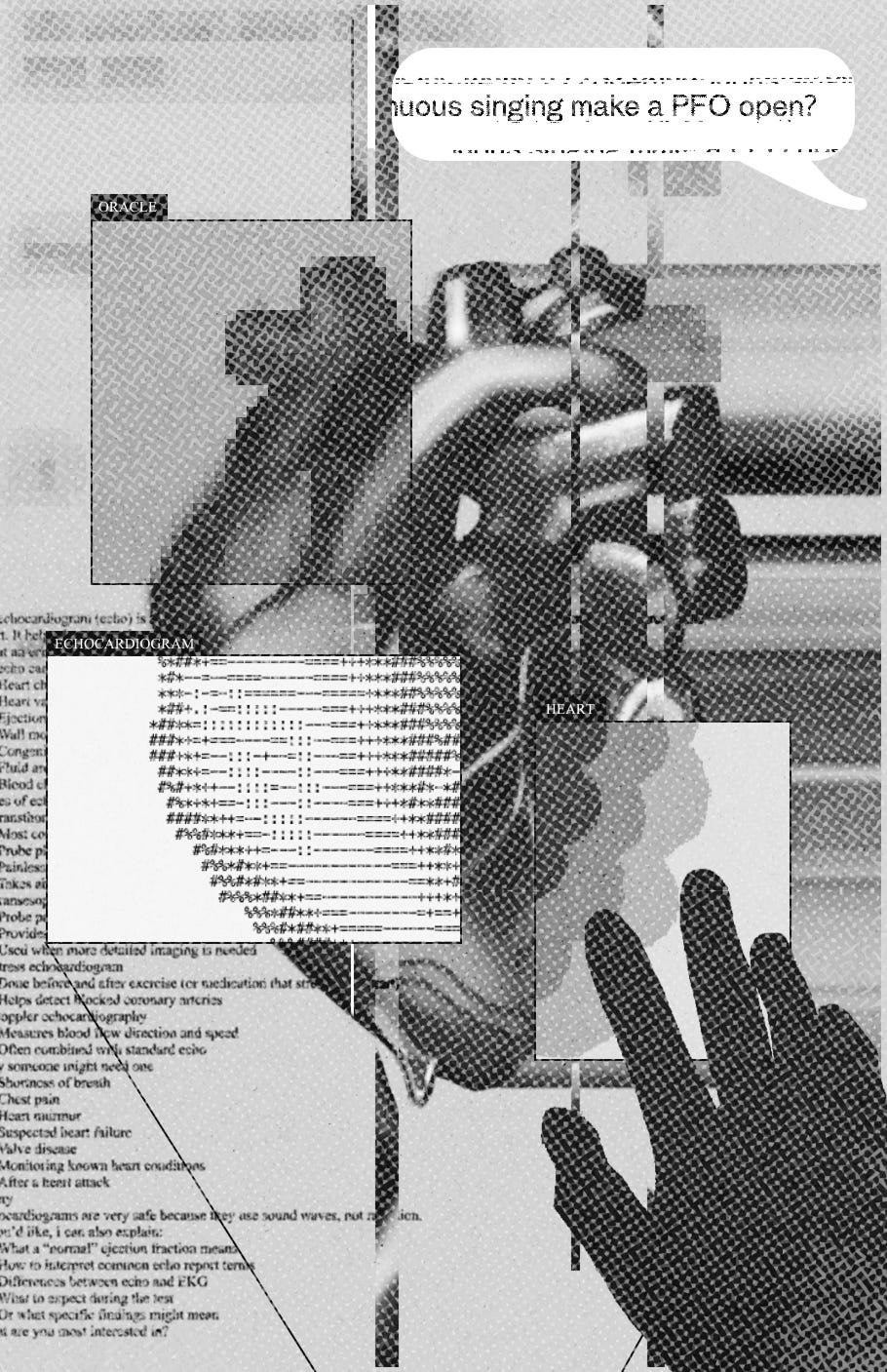
can strenuous singing make a PFO open? I asked. Yes, the Oracle replied, high pressure from intense vocalization can cause a PFO to open temporarily.
“Oh my god,” said Alice when I reported the Oracle’s diagnosis. “Are you really quitting singing because of a heart condition you might not even have?”
“What do you think I should do instead?” I asked.
“Just do what you want,” she said. “And maybe stop asking the Oracle so many questions. It’s not even giving you the information you need, like the incidence rates for PFO opening from singing, probably because nobody has ever measured that.”
“That’s just a prompting issue,” I said. “I could ask for estimates.”
“Could you?” she challenged. “The estimates would be unreliable, so could you also get confidence intervals and standard errors? And once you had all that information, would you know what to do with it?”
“Maybe I wouldn’t know,” I admitted, “but I could ask the Oracle to put everything together.”
* * *
I spent the next workday doing exactly that. At first I worried it would be obvious I was off-task, the way my screen was filled with Oracle chats instead of code, but to my surprise people complimented me.
“I’m glad you’re finally using the Oracle to help you with work,” my manager said. “I was getting impatient with you writing code manually.”
My coworkers had recently transitioned to having the Oracle write all their code. I spend my whole day narrating to the Oracle and approving its suggestions, one of them had said. I hadn’t made the transition myself because I didn’t care enough to work faster.
Perhaps I was doing something similar at home though. I thought about all the late nights over the last few weeks — me hunched over my phone, supplying the Oracle with every detail about my medical history, the same dark silhouette against the same blue light day after day. An alien observing Earth for the first time might conclude we’d already merged with our machines.
The Oracle finished its report, calculating that I should probably stop singing. As I read through the cost-benefit analysis, I felt disappointed. All my life I’d been letting go of things before they had a chance to hurt me. It felt like being made of air — nothing would ever penetrate me, but I couldn’t hold onto anything either.
* * *
I didn’t make it through warmups at the next choir rehearsal. We were drilling our usual arpeggios, but when I tried to hit a note my throat refused to cooperate, as if I’d suddenly lost my voice. An argument unfolded inside my head: What if the breath you’re taking right now is the one that opens the hole in your heart. No, that’s absurd, I’m not even singing that forcefully. But remember what the Oracle said, it is possible, just like Josh with his lung. I’ll be fine, I’ve been singing for 10 years with no issues. But you know singing can force the hole open, it’s just a matter of time, this isn’t rational. Shut up shut up—
I ran to the bathroom and held my breath and splashed cold water all over my cheeks, a trick I’d heard about fighting anxiety with the diver’s reflex. I tried the arpeggios again, but I couldn’t find the notes.
Josh walked in. “Are you okay?”
“No,” I mouthed, the sounds refusing to come out.
“You’ll survive,” said Josh, while grabbing my palm. I was startled by how warm his hand was, like a mitt that had just come out of the oven. The contact alone was enough to distract me. Already the voices in my head were forgetting what they’d been arguing over.
“Look at me.”
I stared into his eyes, only half a foot away from my own, close enough for me to distinguish the dark browns from the blacks.
“Imagine yourself giving the best performance of your life.”
I pictured myself singing my favorite duet, “All I Ask Of You,” with Josh as the upper voice. Say you’ll share with me one love, one lifetime, the song went.
“Now take a deep breath and start!”
Somehow I trusted him even when I couldn’t trust myself. For once my body did exactly as it was told, and the bathroom walls echoed with resonance.
* * *
There were only a few hours left until my echocardiogram, and I was realizing just how much I didn’t know about it.
If I do have a PFO, what are next steps? I asked.
The Oracle’s reply: Followups may be performed to get a clearer picture of the PFO, such as a TEE procedure where a probe is guided down your esophagus. A catheter-based procedure may be recommended to seal the hole.
I hated the idea of tubes going down my esophagus and veins. Does the catheter procedure have any risks? I asked.
The Oracle: While effective for stroke prevention, PFO closure via catheter can have long-term complications. Atrial fibrillation problems (irregular heartbeats) have been observed in 7.6% of patients.
I didn’t want to admit it, but I had no clue what to do with all the information I was getting. If I found a PFO and had it repaired, would I just spend the rest of my life worrying about fibrillation? Was it even worth repairing, given that PFO was usually harmless? What if the doctor was right and the stroke was just a migraine? And even if everything worked out, would I just fixate on other concerns, like microplastics?
“Shocker,” said Alice when I told her about my dilemma.
“Also, there’s another new problem in my life.”
I told Alice about Josh, and how he was unusually good at regulating emotions, and how we’d been texting a lot, and how he’d intervened when he noticed me having a panic attack.
“It sounds like you’re getting along well,” said Alice.
“I’m not sure if he likes me though.”
“You mean after he held your hand and you sang a love duet together?”
“Maybe he was just being polite.”
“Oh my god,” said Alice, exasperated. “Go ask him then. You’ll never be sure until you ask.”
“But like, if you had to guess, what would you say is the probabil—”
“Oh my god,” Alice interrupted. “I’m your human Oracle.”
“What?”
“You’re using me just like you use the Oracle. It’s just like with singing. You overcomplicate things and try to calculate the probability of every outcome, as if you’re trying to predict the future before you actually do anything.”
“I’m not trying to predict the future,” I said. “I just want other peoples’ opinions.”
“Yeah, and one of those opinions comes from an entity known as THE ORACLE which is a language model trained via NEXT-TOKEN PREDICTION. Predicting the future is literally its only job.”
“Fine,” I said. “I still don’t see what’s wrong with asking for advice.”
“That’s not all. You also moved cities and got a bad job to live near me. What exactly am I to you?”
Shit. I’d always wondered how far you could get in life just by finding and following good people, but she’d finally caught on.
“Say something!”
“You…” I trailed off, unsure how to compress years of admiration into words. “You’re the most incredible person I’ve ever met. All I want is to be like you. People in this city are always saying to just be more agentic, but I have no idea how to, and I thought maybe if I spent enough time around you and listened to enough of your advice I would figure it out.”
“That’s bullshit,” said Alice. “You don’t actually want to be like me.”
“What do you mean?”
“I grew up making my own decisions without guidance or role models. So trying to become like me by following advice doesn’t make any sense.”
I recognized the contradiction as well — that my favorite parts of Alice could not be imitated directly. But what did I want advice for then? I thought back to my chats with the Oracle, to all the times I looked to Alice for approval, to my encounter with Josh in the bathroom.
“I think I’m kind of pathetic,” I blurted out. “I think maybe I just need someone to tell me what to do. And they don’t even need to be particularly smart or correct, they just need to be confident enough for me to believe them, because I have such a hard time believing myself.”
“You know what’s going to happen if you keep doing this?” asked Alice.
“No?”
“In a few years the Oracle will have achieved superintelligence, and you will be its slave.”
By then I was crying, and as Alice approached me all I could think was please don’t kick me out.
She hugged me.
“I’m never giving you advice again, ever, but it’s because I care about you. I hope you figure things out. ”
* * *
I was in the lobby of the cardiologist’s office for my appointment, and I zoned out as she began explaining the echocardiogram. The Oracle had already described the procedure to me. It really was a future-predicting machine, the way I was using it.
It’s kind of interesting, I mused as the cardiologist droned on, that ultrasound is just regular sound waves but at pitches inaudible to humans. That similarly high-frequency waves from nearby phones and cables can interfere with the signals you receive, so we sometimes turn off other devices in the room to get a higher-quality image. That the best method we have for imaging the heart is by listening carefully to the sounds it produces.
But wasn’t it the same with my metaphorical heart too? That if I wanted to visualize its exact shape and structure and function, to understand my own feelings and desires, there was no way to do that but to listen? To listen to the flutters and whimpers that had until now gone unnoticed, the heartbeats that required an attentiveness beyond what human ears were built for, the shudders that could not be heard unless every confounding source of noise was removed?
And when I finally did all that, when I finally tuned out everything else and just listened, when I finally performed this echocardiogram on myself, I found that I didn’t want to be at the cardiologist’s office; I wanted to be at my office to put in the two-week notice I’d considered for months or at choir rehearsal to take another stab at singing or —
“Hello? Are you following what I’m saying?” asked the cardiologist.
“Sorry,” I said as I suddenly stood up to leave, “I just realized I need to be somewhere else right now.”
Are you free / at home / can I come over? I texted Josh. Moments later he replied Sure, and before I knew it we were cuddling on his couch. His hands were as warm as I’d remembered, and everywhere they touched my skin livened up like a cold-blooded reptile basking in the sun. He was leaning in to kiss me when I stopped him.
“Wait,” I said. “Can you get a collapsed lung from kissing too hard? Or a stroke?”
“What?” Josh giggled.
I pulled up the Oracle and began typing when Josh reached over and put my phone to sleep. Trust me? his face seemed to be asking, and I thought yes, I will trust you; yes, I will trust myself; yes, I will try to surf these waves instead of running from them, and we started kissing and kissing as if it would kill us, as if any moment now my brain would stop or his lung would collapse, but neither of them ever did.
Thanks for reading — if you enjoyed this short story, we’d really appreciate it if you shared or forwarded to a friend!
