


Kernel 6 is live now! It is an extremely beautiful magazine featuring 200 pages of essays, poetry, short fiction, illustrations, and experimental cocktail recipes! What more can I say?
Come to our SF Launch Party at TIAT on July 17 — we’ll have Costco sheetcake and the aforementioned experimental cocktails for you to feed on!
This Saturday, we are officially releasing Kernel Magazine’s sixth issue, themed around the inescapability of the Feed! Every issue of Kernel takes a village to make, and this one was no different; without the labor of a few dozen writers, illustrators, editors, and designers, none of this would be possible. Thank you all.
To introduce you to the issue, here’s my editor’s note, including a digression into the history of early internet magazines and a paean to ecosystem engineering:
✍️ Editor’s Note
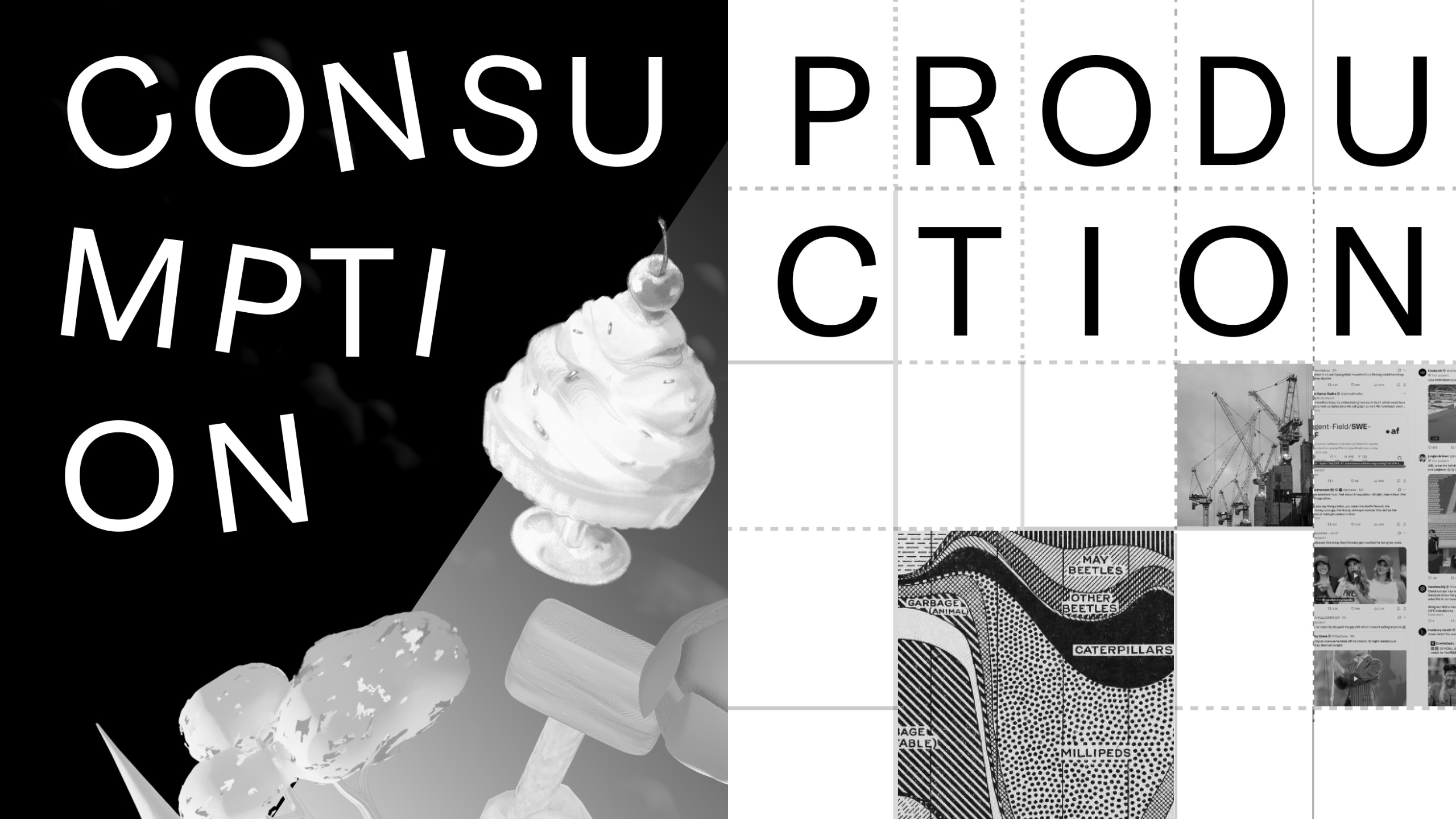
by Jacob Kuppermann
Dear reader,
This issue of Kernel Magazine is about what we consume and what consumes us.
We were told a decade and a half ago by certain invested parties that software was eating the world. If that was true, what stage of digestion have we reached now? This issue’s theme is Feed; here, we refer to the feeds and flows that fuel contemporary society, be they agricultural, industrial, or informational.
Like the themes of our last two issues, Luck and Rules, Feed is an old concept given new lives in technological advancement — first by the industrial revolution’s reordering of the world, and then by our contemporary technological moment’s further revision to that order. The feed was transfigured from an agricultural and ecological term, associated with rivers feeding into oceans and pigs feeding at troughs, to an industrial one for any sort of mechanically supplied material. This shift occurred sometime in the early span of the long 19th century, as a dazzling new array of machines and processes required an increasingly systematized process of feeding. From there, new conceptual leaps brought the feed to the further-afield realms of transit (feeder lines), education (feeder schools), telecommunications (broadcast feeds), and then, at the turn of the century, the nascent online, via RSS and other data feeds. From fodder to feedstock to algorithmic feeds, this progression became a sort of semantic feed in itself, its meaning growing more abstract, never losing the kernel of transmission and consumption at its core.
FEEDs feed us, propel us, consume us. In producing this issue of Kernel, we were inspired by one of the first online-native magazines. It, too, was called Feed. It, along with its sister publication Suck, shuttered in 2001, as the internet was in the midst of reshaping itself around feeds of information rather than loosely linked individual pages. Feed was founded in 1995, before RSS feeds or the Facebook News Feed brought the feed to the forefront of online infrastructure. Even then, though, it was clear that the constant flow of information that characterized the experience of interfacing with the early web required new uses for old vocabulary. In the decades since, the feeling of inundation and glut — of too much to know1 — of these early online feeds has only intensified, especially with the advent of large language models trained on oceans upon oceans of data.
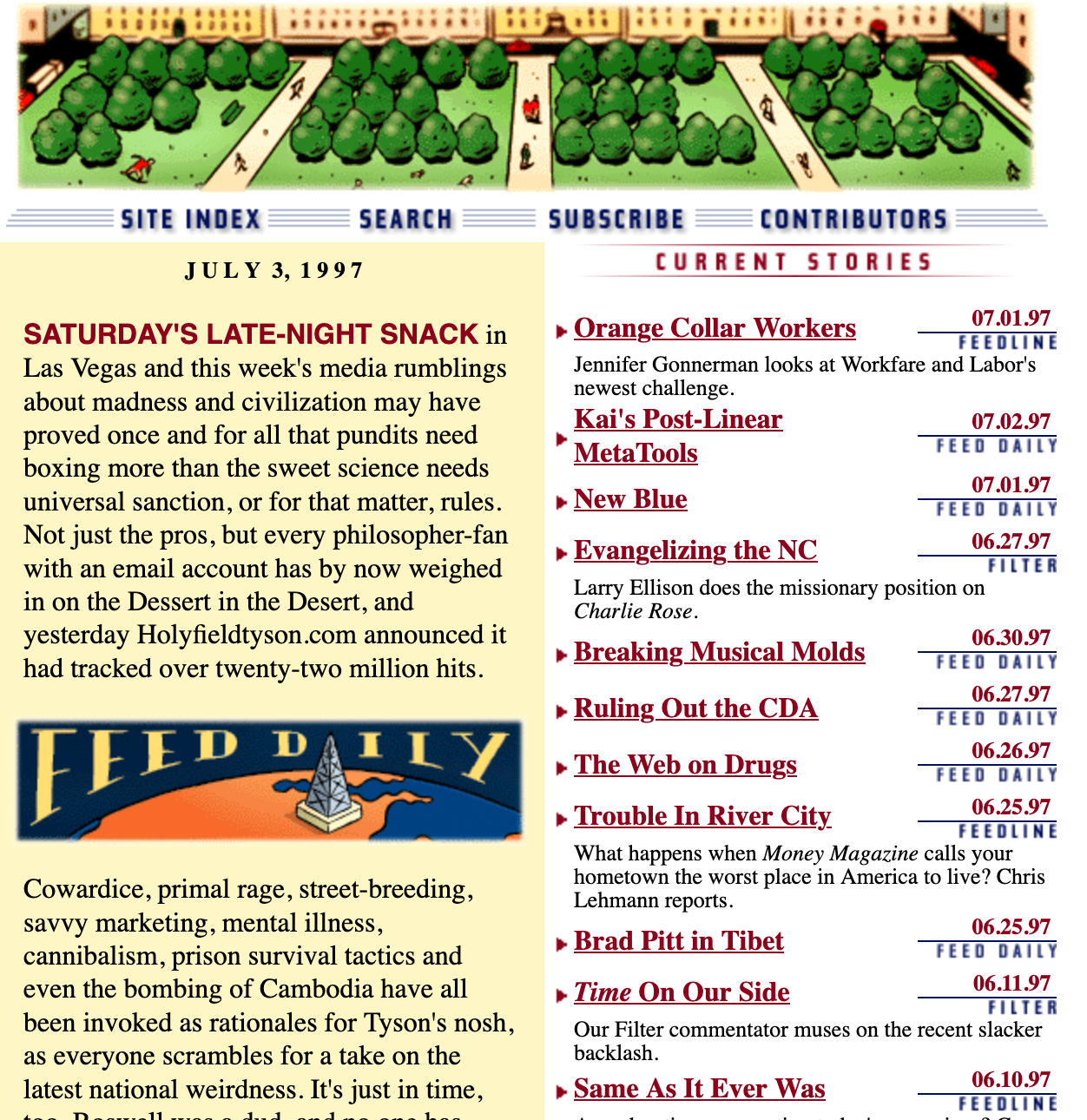
Feeds, as we encounter them in our daily lives, entrain us. We become accustomed to their regimented motion, whether that takes the form of the much bemoaned pattern of doomscrolling through half-dead social media sites or through the patterns of physical routing that the aisles of a grocery store or the lanes of a highway compel us towards.
Feeds imply a certain regularity — the same illusion of constancy that allows water in laminar flow to seem like a single unchanging column rather than a jostling armada of individual molecules. The totalizing gaze of the Facebook feed at its most imperial, the oceans of data fed into large language models as they train, the anonymous network of container ships and semi trucks that feed the global economy: all of these gargantuan apparatuses of transmission and consumption operate at volumes and consistencies beyond any individual’s comprehension. That consistency is best observed in its absence — consider the shock of the six hours Instagram and Facebook’s feeds were down in 2021, or the ongoing (as of this writing) crack-up of the global supply chain as the feed of petrochemicals and nitrogen fertilizers from the Strait of Hormuz has halted in retaliation against the United States’ war upon Iran. A well-functioning feed fades into the background. A broken one feels catastrophic.
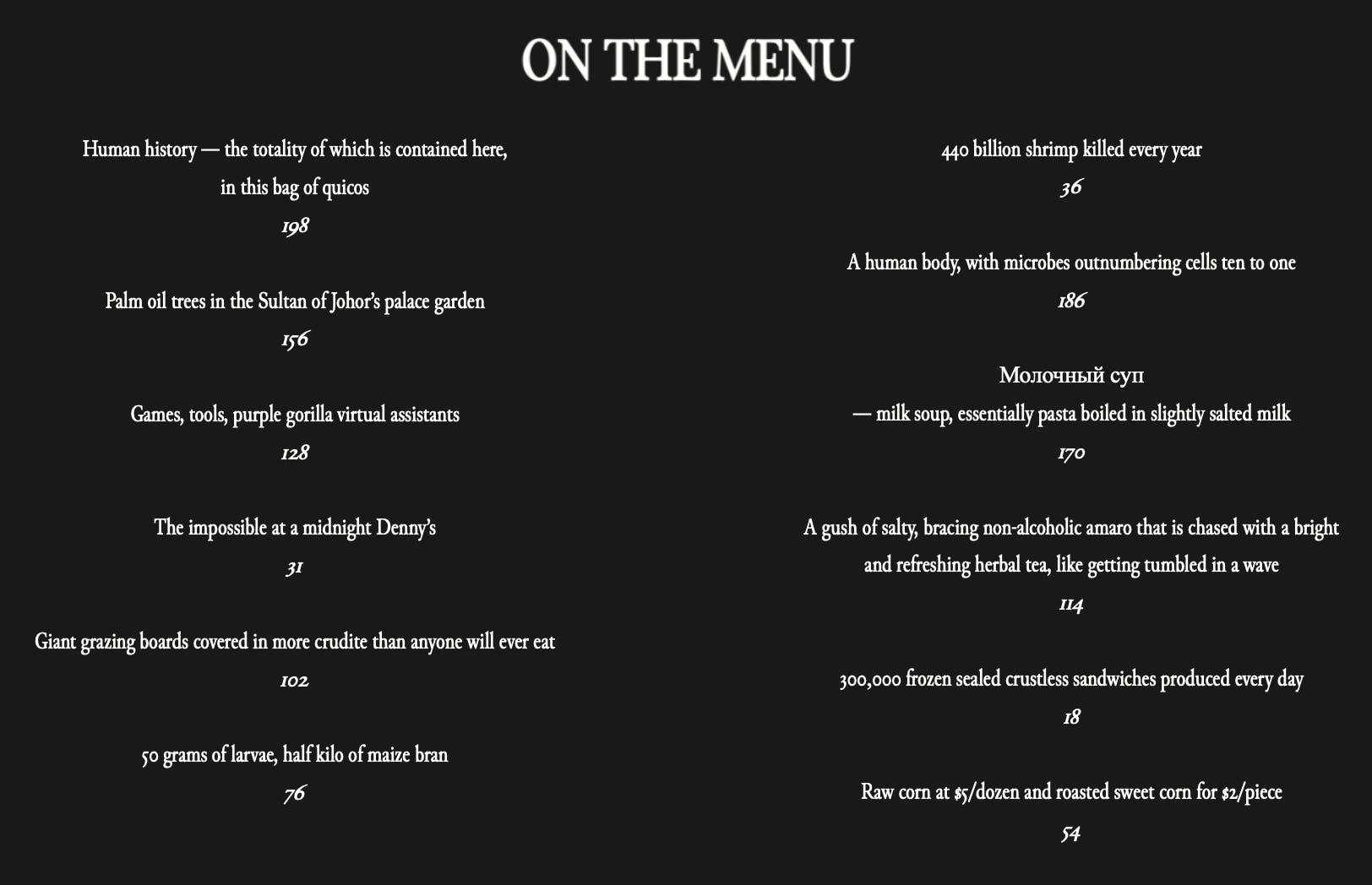
The stories in this issue of Kernel aim to bring the feed out of the background. Our writers were tasked with unveiling the machinery that feeds our contemporary world, both in literal senses — as in the case of Justin Lin’s meditation from a factory producing frozen seamless crustless sandwiches, Evan Hamilton’s pre-mortem for Instagram-friendly haute cuisine, and Jonathan Feakins’ interview with Sarah Nawoya, a researcher from Uganda using computer vision to improve insect agriculture — as well as more figurative ones — Ann Ravinther’s dispatch on three cycles of exploitation in Johor, Malaysia, Tomás Guarna’s media history of the infinite scroll, Spencer Chang’s portraits of daily online feed use. These stories investigate how we think about our food — both ethically, in Alex Wennerberg’s investigation into the world of shrimp welfare, and epistemologically, as in Sophie Wu’s paean to Wikipedia’s collection of articles on food. This issue also contains stranger diets, too — Vicki Xu’s profile of a Claude agent set to the task of growing corn, Isabel Paban Freed’s Rabelaisian meditation on the gustatory qualities of Twitter usage, and more. We even have some cocktail recipes from M Kuznetsov, if you need an aperitif.
Of course, our relation to feeds is not purely a consumptive one. Even now, we are able to shape the feeds we live in, much like how ecosystem engineers of both human and beaver-kind have shaped rivers to their will. The imagery of the feed begs us to think of ourselves as passive downstream byproducts, but feeds always imply feedback. Perhaps, then, we should think of ourselves as part of some technological ouroboros, snakes eating our own tails, constantly with the hope of rebirth into something better; something new.
Eat up!
Jacob Sujin Kuppermann
Editor-in-Chief
Kernel Magazine, Issue 6
You can read more about Kernel at feed.kernelmag.io, a microsite designed by our Creative Director Connie Liu featuring illustrations from the issue. We’ll be sending more pieces from Kernel tomorrow on launch day and all throughout August — and if you’re in the bay, see you at TIAT!
Until then,
The Kernel Magazine Team
This is an older feeling than you might expect; read, for example, Ann Blair’s work on early modern information management, and gain a deep sense of kinship with the scholars and bookkeepers of the 17th century Dutch Republic, stressed about information overflow in the face of the glut brought on by the printing press.